


The most common startup scams founders run into while raising capital are:
- The advance fee investor scam
- The pay-to-pitch scheme
- The advisor-for-equity salary trap
- The personal guarantee term sheet
- The cloned VC website
- The decoy investor finder's fee
- The fake crowdfunding platform
I almost added Alpha Hub to the list of companies that lost money to one of these. Not because we were careless. We had a credible introduction, a "family office" that asked sharp questions, and weeks of conversation that felt like real diligence. It still nearly cost us five figures before something felt off enough to stop and check.
Founders are exposed to this kind of thing more than most people realize. Investment scams accounted for $7.9 billion in reported losses in 2025, with a median individual loss over $10,000, according to the FTC. A separate FTC report put total fraud losses at $15.9 billion for the year, up sharply from 2024. Founders are a specific kind of target: you're taught to move fast, stay optimistic, and not let a slow process kill your round. The median time from seed to Series A is now 774 days, according to Carta, and it can take more than 200 investor conversations to close a seed round, per NYU Entrepreneurship research. That kind of pressure is exactly what scammers count on. Here's what to watch for, starting with the one that almost got us.
1. The Advance Fee Investor Scam: How a "Family Office" Almost Cost Us Our Seed Round
The advance fee investor scam works by getting you to pay a fee, often disguised as legal costs, taxes, or wire charges, before any real money ever moves. About six months ago, we were introduced to a group presenting themselves as a Switzerland-based family office. The introduction came through someone we trusted, which is exactly why we let our guard down a little.
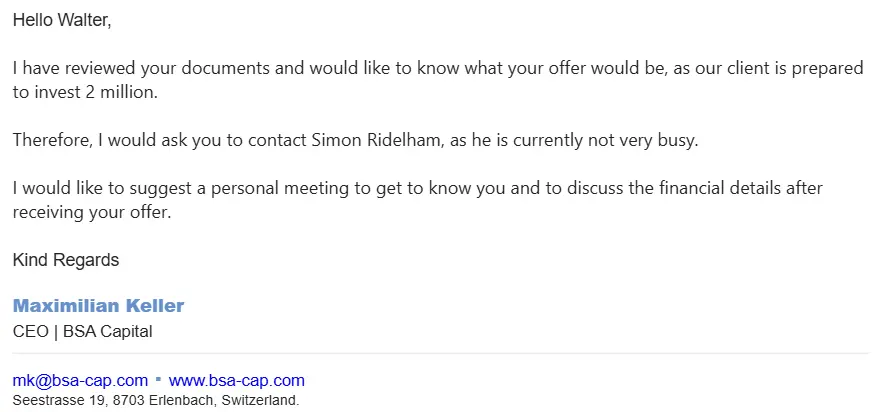
The back and forth was extensive. Emails, calls, the right questions about our business. They looked credible. Then it came down to closing the deal, and they insisted we fly to Switzerland for a face-to-face meeting. They even offered to reimburse our travel costs once the deal closed.
Here's where it started to feel wrong. When we got into the agreement itself, including valuation and a few other major terms, they barely pushed back. No real scrutiny of the documents. In my experience, a genuine investor doing due diligence asks harder questions the closer you get to signing, not fewer. That mismatch was the first real signal.
The second signal: I was told I'd be introduced to someone else on their team, and that person never quite materialized as a real, verifiable individual. When I tried to confirm who I was actually dealing with, the details didn't hold up.
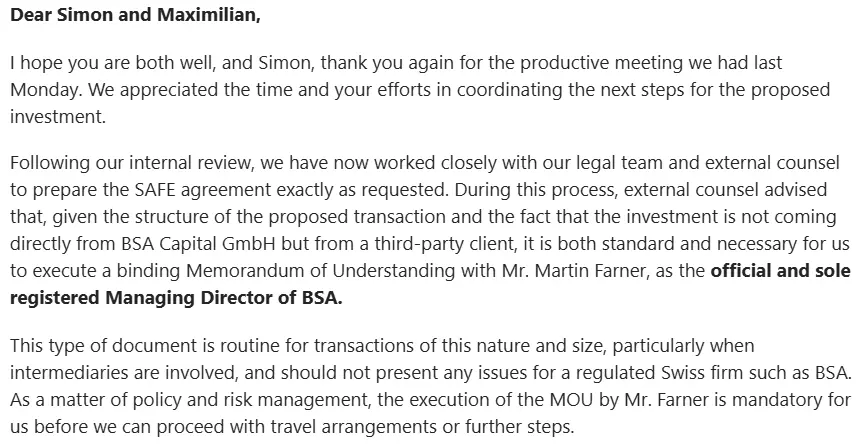
So I did the research instead of getting on a plane. What I found matches a well-documented pattern: a group invites a founder to a country in Europe for an in-person closing, then introduces an "advance fee," often requested in Bitcoin under the cover story of proving you have a wallet or covering contract costs. Once you've already spent the time and money to travel, you're more inclined to pay the fee just to see it through. Reported losses in cases like this have ranged from roughly 50,000 to 250,000 EUR. I also checked the registrations the group had provided. A couple of them didn't hold up: the individuals claiming to represent the company didn't appear to have legal authority to sign on its behalf, and licensing requirements for what they claimed to do weren't actually met.
Ultimately, once we asked them to have their fictitious family office investor sign a Memorandum of Understanding based on the guidance of our legal team, they dissapeared and the conversation stopped there.
We're not the only ones this has happened to. One founder who described a nearly identical setup, an unsolicited approach, a deal that looked too generous, and a demand for an upfront fee in cash or Bitcoin before funds would move, walked away only after noticing the same kind of pressure tactics we did. The shape of the scam barely changes from case to case. What changes is whether the founder catches it in time.
What we do differently now: every document we share with a potential investor goes through a permissioned data room with NDA gating, so nothing sensitive moves until terms are in place. And one lesson from this experience stuck with me: if an investor isn't actually spending time reviewing your materials before pushing to close, that's a red flag worth taking seriously. Visibility into who's engaging with your data room and how closely is something we're building into Alpha Hub directly, and it can't come soon enough.
2. The Pay-to-Pitch Scheme
A pay-to-pitch scheme charges founders for the opportunity to present to a room of investors, with no funding guaranteed in return. It usually shows up as an "exclusive" demo day, an investor forum, or a syndicate event, and the price tag for a seat ranges from roughly $5,000 to $20,000, according to Crunchbase research on scam-adjacent fundraising activity.
The logic should bother you immediately. A serious investor wants to see strong companies and has every incentive to make that easy, not expensive. When an event flips that relationship and charges the founder instead of the investor, the business model has shifted from "find good deals" to "collect entry fees." Some of these events are legitimate paid conferences with real value. Plenty are not, and the difference usually comes down to whether anyone who attends actually gets funded.
Best for: nobody, unless you've independently verified actual portfolio companies that came out of the event with checks in hand, not just intros.
3. The Advisor-for-Equity Salary Trap
This scam disguises a loan as an investment by requiring you to put the "investor" on payroll. The pattern: someone agrees to invest, say $40,000, but only if you also pay them a few thousand dollars a month as an advisor. Within a couple of years they've recovered all or most of their original investment in cash, while still holding the equity they got at the time of the deal.
A real investor advises because it protects their own investment, not because they need a salary. If someone wants both equity and a paid seat at the table before you've even closed, that's not really an investment. It's a loan with extra steps, and the math almost always favors them, not you.
4. The Personal Guarantee Term Sheet
A personal guarantee term sheet asks the founder to personally repay the investor if the company fails. On paper it can look like a normal investment agreement. Buried in the terms, though, is language that converts the "investment" into a disguised loan the founder is on the hook for personally, which defeats the entire point of raising equity capital in the first place.
Venture investment is supposed to carry risk for the investor. That's the deal. If a term sheet shifts that risk back onto you personally, you're not raising venture capital anymore. Read every term sheet line by line, and if anything resembles a personal repayment obligation, get a fundraising-experienced lawyer to flag it before you sign.
5. The Cloned VC Website
A cloned VC firm copies a real, well-known investor's brand, website, and portfolio to look legitimate while operating a completely separate scam. The tactics are consistent: a domain that's one character off from the real firm's (.co instead of .com, an added hyphen), stock photos standing in for real team members, and a list of "portfolio companies" that have never heard of them.
This isn't hypothetical. In one documented case, an MIT alumnus built an entire venture fund, Asenqua Ventures, around fabricated credentials and a fictitious track record before it unraveled. Before you take a call seriously, run a WHOIS lookup on the firm's domain to check how recently it was registered, and cross-reference the partners and portfolio against Crunchbase or AngelList. A firm with a real track record leaves a real trail.
6. The Decoy Investor Finder's Fee
A decoy investor offers to make introductions to real investors in exchange for an upfront retainer, a backend finder's fee, or both, without any guarantee the introductions will lead anywhere. They position themselves as a connector rather than an investor, which makes the fee feel more reasonable than it is.
The problem is structural: once they're paid, their incentive to actually deliver results drops. A genuine connector who believes in your company will usually take a success-based fee or a small equity stake tied to an actual closed deal, not cash up front for promises.
7. The Fake Crowdfunding Platform
A fake crowdfunding platform looks like a legitimate, founder-friendly way to raise capital, but the platform itself isn't registered, isn't secure, or isn't even real. You upload your pitch, start sharing it, and either the funds raised never reach you, or the platform quietly harvests the data you submitted and disappears.
Before committing to any crowdfunding platform, verify its registration status, look for a real, named team you can independently confirm, and search for prior campaigns that actually paid out. No verifiable track record is itself the answer to whether you should use it.
What Should Founders Look for When Vetting a New Investor?
Founders should look for verifiable identity, a real track record, and behavior that matches what a genuine investor does during due diligence. That means confirming the individual's legal authority to represent the fund, checking registration and licensing where it applies, and watching how closely they actually engage with your data room and financials. A real investor digs in. Someone running a scam usually wants you to skip the parts where scrutiny would catch them.
Beyond identity, watch the deal terms themselves. Does the valuation make sense given your stage and traction, or is it unusually generous for no clear reason? Is there any language that shifts financial risk back onto you personally? Are you being asked to pay anything, ever, before money moves in your direction? Every "yes" to those last two questions is a reason to stop.
How Can Founders Verify an Investor Is Real Before Signing Anything?
Founders can verify an investor is real by independently confirming their identity, checking the fund's domain registration date, and cross-referencing their claimed portfolio against public sources. Don't rely on the contact information the investor gives you. Look the firm up separately, find a phone number or email through their actual website (checking that the domain matches exactly), and ask direct questions about other founders they've backed who you can speak with yourself.
For accredited investor or family office claims specifically, ask for documentation rather than taking the description at face value. A legitimate investor expects this kind of scrutiny and won't push back on it. That's usually the clearest signal of all.
Frequently Asked Questions
The most common startup fundraising scam is the advance fee scheme, where a fraudulent "investor" requests payment, often disguised as legal, travel, or wire fees, before any real investment is made. It shows up across nearly every variation of fundraising fraud, from fake family offices to cloned VC firms, because it's the simplest way to extract money from a founder without ever having to actually fund the company.
Advance fee investment scams work by building credibility through extended conversation, then introducing a fee the founder must pay before funds are released. Common variations include requests for a face-to-face meeting in another country, payment in Bitcoin for "wallet verification," or fees framed as legal or contract costs. The travel and time a founder has already invested makes them more likely to pay the final fee just to see the deal through.
Pay-to-pitch events are not always a scam, but founders should treat any event charging a fee for investor access with caution. Some paid conferences offer real value and legitimate investor exposure. The difference usually comes down to verifiable outcomes: ask for examples of companies that pitched and actually closed funding, not just companies that attended.
If you think an investor is scamming you, stop all payment requests immediately and independently verify the individual's identity and the fund's registration before any further communication. Don't send money for any reason tied to releasing or closing an investment. Consult a fundraising-experienced lawyer before signing anything, and report the attempt to the FTC at ReportFraud.ftc.gov if you've already lost money or believe you were close to it.