
Private Capital Markets CRM — Manage Your Entire Deal Pipeline in One Place
Alpha Hub is the deal flow software built for both issuers and allocators. Track every stage from initial screening to final close — in real time, on both sides of the deal.
Request Your Onboarding Call
Our team will personally walk you through the platform and get your free data room set up.
From First Contact to Final Close — Every Stage of the Deal
Screen and Initial Review
The first stage of any deal is also the most critical filtering point. When an allocator receives a new opportunity, it enters the pipeline at Screen and Initial Review — where the investment team assesses fit against their thesis, sector focus, and check size criteria. On Alpha Hub, issuers can see when their deal has entered this stage, removing the uncertainty of cold outreach and giving both sides a shared starting point for the relationship.
Due Diligence
Due diligence is where investment decisions are made or lost. At this stage, allocators review financial statements, legal documents, cap tables, and operational data — cross-referencing every claim in the pitch against the underlying evidence. Alpha Hub connects the deal flow pipeline directly to the issuer's data room, meaning the documents needed for diligence are already organized and accessible the moment a deal advances to this stage. No more chasing documents over email.
See how the data room connects →Investment Approval
Investment approval is the internal decision point — the moment a deal moves from evaluation to conviction. At most firms this involves an investment committee review, a formal recommendation, and a vote. Alpha Hub's pipeline reflects this stage clearly for both parties, so issuers know their deal is under active consideration at the highest level of the allocator's organization rather than sitting in an unanswered inbox.
Term Sheet Negotiation and Issuance
The term sheet stage is where the financial and structural terms of the investment are proposed, negotiated, and agreed. Key variables — valuation, ownership stake, board composition, liquidation preferences, and pro-rata rights — are worked through at this stage before legal documentation begins. Alpha Hub surfaces this stage transparently in the pipeline, giving issuers real-time visibility into where their deal stands in the allocator's process without requiring a follow-up call to find out.
Legal Documentation and Final Agreements
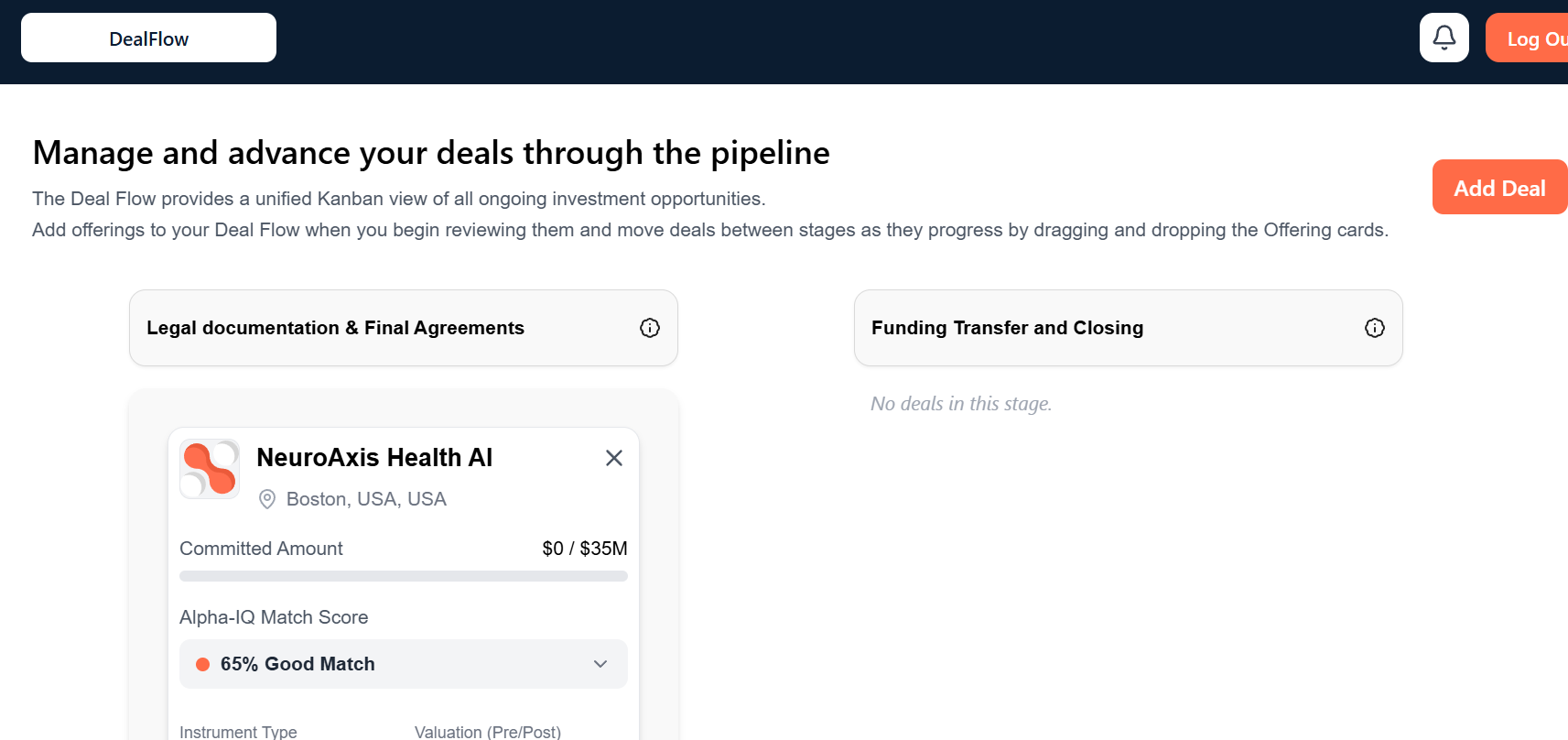
Once terms are agreed, the deal moves into legal documentation — the drafting and execution of definitive agreements including the stock purchase agreement, investor rights agreement, and any side letters. This stage is frequently where deals slow down, with multiple parties — founders, investors, and legal counsel — coordinating across dozens of document versions. Having both sides of the deal on the same platform reduces friction and keeps the process moving toward close.
Funding Transfer and Closing
Funding transfer and closing is the moment capital moves. Wire instructions are confirmed, agreements are executed, and the investment is formally completed. Alpha Hub tracks this stage explicitly so both the issuer and allocator have a shared record of where the transaction stands — eliminating the ambiguity that often characterizes the final days of a close.
Deal Completion
Deal completion marks the formal end of the transaction process and the beginning of the post-investment relationship. At this stage the deal is logged as closed, documents are filed, and both parties transition from transaction mode to portfolio management. Alpha Hub records deal completion as a milestone in the pipeline, creating a clean audit trail of the full transaction lifecycle from first contact to final close.
Asset Transfer Status
Asset transfer status tracks the movement of equity, securities, or other assets following close — confirming that the transfer has been initiated, processed, and confirmed on both sides. Once the transfer is verified, Alpha Hub initiates the digitization of the securities, converting closed deal terms into structured digital tokens recorded on a permissioned blockchain. This creates an immutable, on-chain record of ownership that both issuers and allocators can access in real time — replacing fragmented paperwork with a single source of truth and laying the groundwork for portfolio management, compliance tracking, and future liquidity.
How to Manage Your Deal Flow on Alpha Hub
Create your issuer or allocator profile
Sign up and tell us which side of the deal you are on. Alpha Hub tailors your pipeline view and matching criteria from day one.
Add and track your deals
Issuers submit their offering and data room. Allocators receive and review inbound opportunities. Every deal enters the shared eight-stage pipeline automatically.
Move deals forward in real time
Drag deals between pipeline stages as they progress. Both sides see every move as it happens — no follow-up calls required.
Built for Every Player in Private Capital Markets
Venture Capital Firms
Manage inbound deal flow, track opportunities through your IC process, and give founders real-time visibility into where their deal stands.
Private Equity Funds
Replace spreadsheet-based pipeline tracking with a structured deal flow tool built for the complexity of PE transactions.
Family Offices
Manage direct investment opportunities with the same pipeline discipline as institutional funds — without the enterprise price tag.
Startups & Founders
Track exactly where your deal stands in every investor's pipeline without sending a single follow-up email.
Growth-Stage Companies
Manage multiple investor conversations simultaneously and stay organized through every stage of your Series A and beyond.
Emerging Fund Managers
Run a professional deal pipeline from day one — built for the way private capital actually works, not adapted from a sales CRM.
What Is Deal Flow Management and Why Private Capital Needs Better Infrastructure
Deal flow management is the process of systematically identifying, tracking, evaluating, and closing investment opportunities across every stage of the transaction lifecycle. For capital allocators, including venture capital firms, private equity funds, family offices, and institutional investors, it is the operational backbone of the investment process. For issuers, including founders, growth companies, and fund managers raising capital, it is the invisible process that determines where their deal stands and whether it will ever close.
The challenge is that private capital markets have never had proper infrastructure for this. For decades, deal flow has been managed through spreadsheets, email threads, and generic CRM tools adapted from sales processes that were never designed for investment workflows. The result is a system characterized by missed opportunities, duplicated outreach, and a fundamental lack of visibility on both sides of every transaction.
The scale of this inefficiency is significant. According to the 2024 Deal Origination Benchmark Report by Sutton Place Strategies, the average private equity firm sees just 16.5% of relevant deals in its target market, meaning more than 80% of potential opportunities never reach the right desk. At the same time, the average PE firm evaluates 80 opportunities before closing a single investment, according to Affinity, a conversion rate of just 1.25%. In an environment where finding quality deals is already difficult, losing visibility on the pipeline at any stage of that process is a liability most firms cannot afford.
For issuers, the experience is equally opaque. A founder submits their deck to twenty investors and has no visibility into what happens next. Did the email land? Was it reviewed? Is it sitting in a pipeline somewhere or was it dismissed in the first pass? The absence of shared visibility between issuers and allocators creates a communication vacuum that slows every stage of the deal, from initial screening through due diligence, term sheet negotiation, and final close.
Alpha Hub is built to replace this fragmented infrastructure with a shared, real-time deal pipeline that both sides of the transaction can see and navigate simultaneously. When an allocator moves a deal forward, the issuer knows. When a deal stalls, both parties have the context to understand why. Deal flow management stops being a black box and becomes a transparent, collaborative process: the same standard that public markets have always provided, now available for private capital for the first time.