

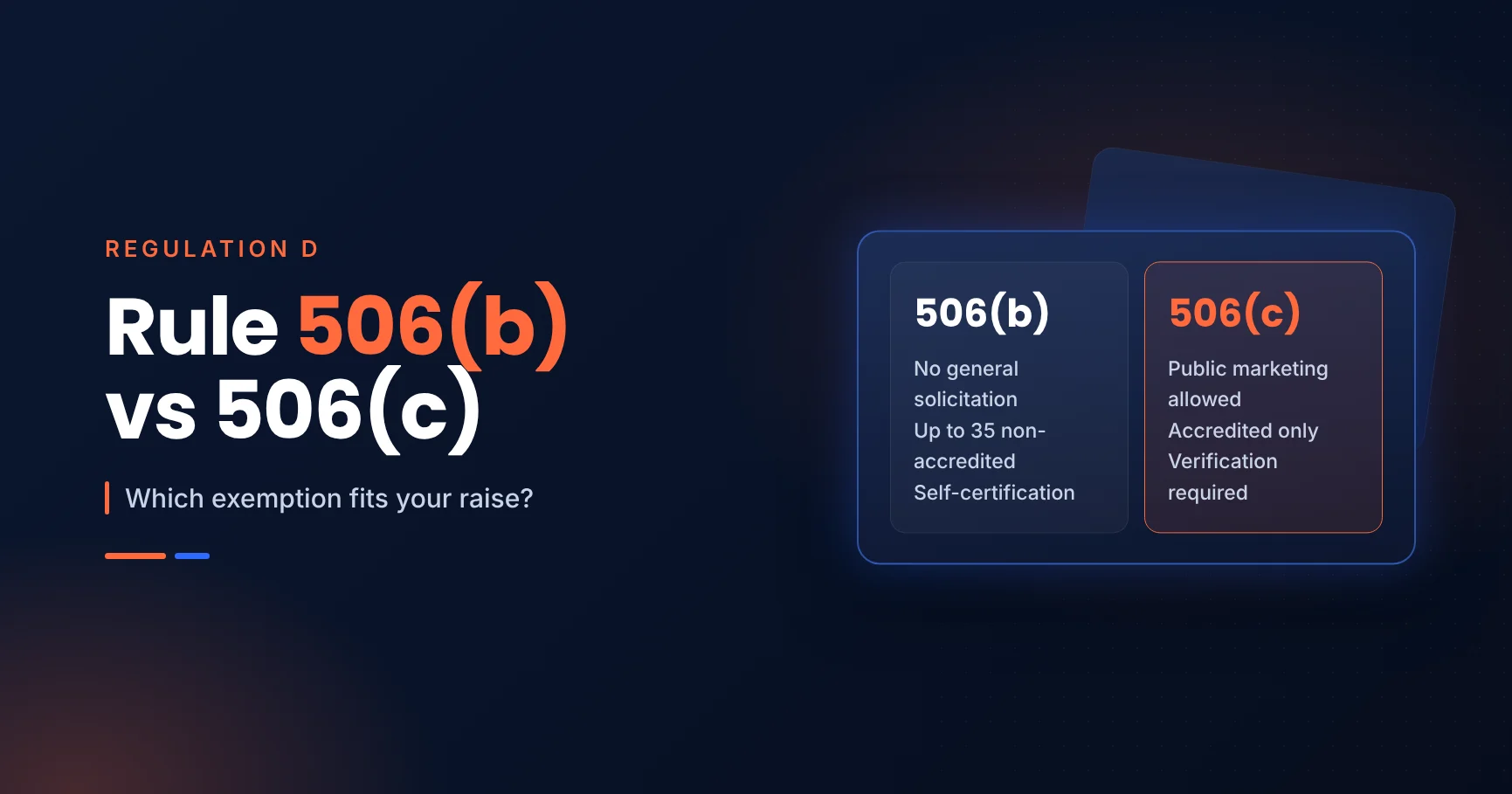
Rule 506(b) and Rule 506(c) are the two private placement exemptions in Regulation D. Both let you raise an unlimited amount without registering with the SEC. The difference is marketing: under 506(b) you cannot publicly advertise the raise, but up to 35 sophisticated non-accredited investors can participate; under 506(c) you can advertise, but every investor must be accredited and you must verify it.
Rule 506(b) vs 506(c) at a Glance
| Rule 506(b) | Rule 506(c) | |
|---|---|---|
| Public advertising (general solicitation) | Not allowed | Allowed |
| Amount you can raise | Unlimited | Unlimited |
| Accredited investors | Unlimited number | Unlimited number |
| Non-accredited investors | Up to 35 in any 90-day period, who must be financially sophisticated (alone or with a purchaser representative) | None |
| Checking accredited status | Reasonable belief, usually an investor questionnaire | Reasonable steps to verify each investor |
| Disclosure to non-accredited investors | Required information, similar to a registered offering, if any participate | Not applicable |
| Form D | Within 15 days of first sale | Within 15 days of first sale |
| State registration | Preempted; state notice filings and fees still apply | Preempted; state notice filings and fees still apply |
Sources: SEC pages on Rule 506(b), exempt offerings and Rule 506.
Rule 506(b): The Traditional Private Placement
Rule 506(b) is a safe harbor under Section 4(a)(2) of the Securities Act. According to the SEC, a company relying on it cannot use general solicitation or advertising to market the securities, and may sell to an unlimited number of accredited investors and up to 35 other purchasers, who must be sophisticated.
In practice, 506(b) works when you raise from people you already know or meet through warm introductions: angels you have pitched, funds that know your investors, your network. "No general solicitation" usually means having a pre-existing, substantive relationship with the people you offer to, rather than reaching strangers through public posts, ads or mass email.
Non-accredited investors are allowed, but they bring requirements. If any non-accredited investor participates, Regulation D requires you to give them disclosure documents similar to those in a registered offering, including financial statements, and be available to answer their questions. That is why most startups limit their 506(b) rounds to accredited investors anyway.
Rule 506(c): Advertising Allowed, Verification Required
Rule 506(c) came from the JOBS Act. Under the SEC's rules, a company can broadly solicit and advertise an offering as long as all investors are accredited and the company takes reasonable steps to verify that, which could include reviewing W-2s, tax returns, bank and brokerage statements, credit reports and the like.
That lets you post about the round on LinkedIn, pitch at a public demo day, list it on a platform or run ads. The cost is the verification step: a checkbox questionnaire is not enough. We cover the methods in detail, including the SEC staff's 2025 position on high minimum investments, in our guide to verifying accredited investors under Rule 506(c).
Which One Do Companies Actually Use?
Most use 506(b). In our analysis of every Form D filed in the 12 months to November 22, 2026, 82.4% of operating company offerings relied on Rule 506(b) and 16.4% on Rule 506(c). Among pooled funds, 91.4% used 506(b) and 8.2% used 506(c). In the most recent 30 days, 506(c) was slightly higher: 17.0% of company offerings and 9.6% of fund offerings.
Those figures come from our weekly Private Raise Report, built from 58,513 offerings on EDGAR. The pattern makes sense: most early rounds come from investors founders already know, so the public-marketing benefit of 506(c) does not outweigh the verification work.
How to Choose
Choose Rule 506(b) if:
- Your investors will come from your network and warm introductions.
- You want to include a few non-accredited friends or employees, and accept the disclosure requirements that brings.
- You do not want to collect financial documents from investors.
Choose Rule 506(c) if:
- You need to reach investors you do not know, through public posts, events, ads or platforms.
- Every investor will be accredited, and you can verify them, or use a verification service or minimum investment approach your lawyer approves.
- You have already talked publicly about the raise. If so, speak with your lawyer before treating it as a 506(b) offering.
Not sure Regulation D is right at all? Our free exemption guide also covers Regulation Crowdfunding and Regulation A, which allow non-accredited investors with different limits and filings.
What Stays the Same Under Both
- Form D within 15 days of first sale. The steps are in our guide on how to file a Form D, and our deadline calculator gives you the date.
- State notice filings. Both are "covered securities", so states cannot require registration, but most require a notice and a fee.
- Bad actor rules. Under Rule 506(d), an offering cannot rely on Rule 506 if the company or certain covered persons, such as directors, officers, large shareholders or paid solicitors, have certain disqualifying events like specified securities-related convictions or orders. Run bad actor checks before you start.
- Anti-fraud rules. Exempt does not mean unregulated. What you tell investors must be accurate under both exemptions.
- Resale limits. Securities sold under either rule are restricted and cannot be freely resold.
How Much Do Companies Raise Under Each?
Form D data shows what companies in your industry and state raised recently. Our free raise benchmarks tool breaks down every Form D from the last 90 days by industry, state and exemption, and our guide to reading a Form D shows how to look up a specific company's filing.
Free weekly reportPrivate Raise Report: what US companies raised this weekEvery SEC Form D filing, turned into raise sizes by industry, state and exemption.See this week’s numbers →