

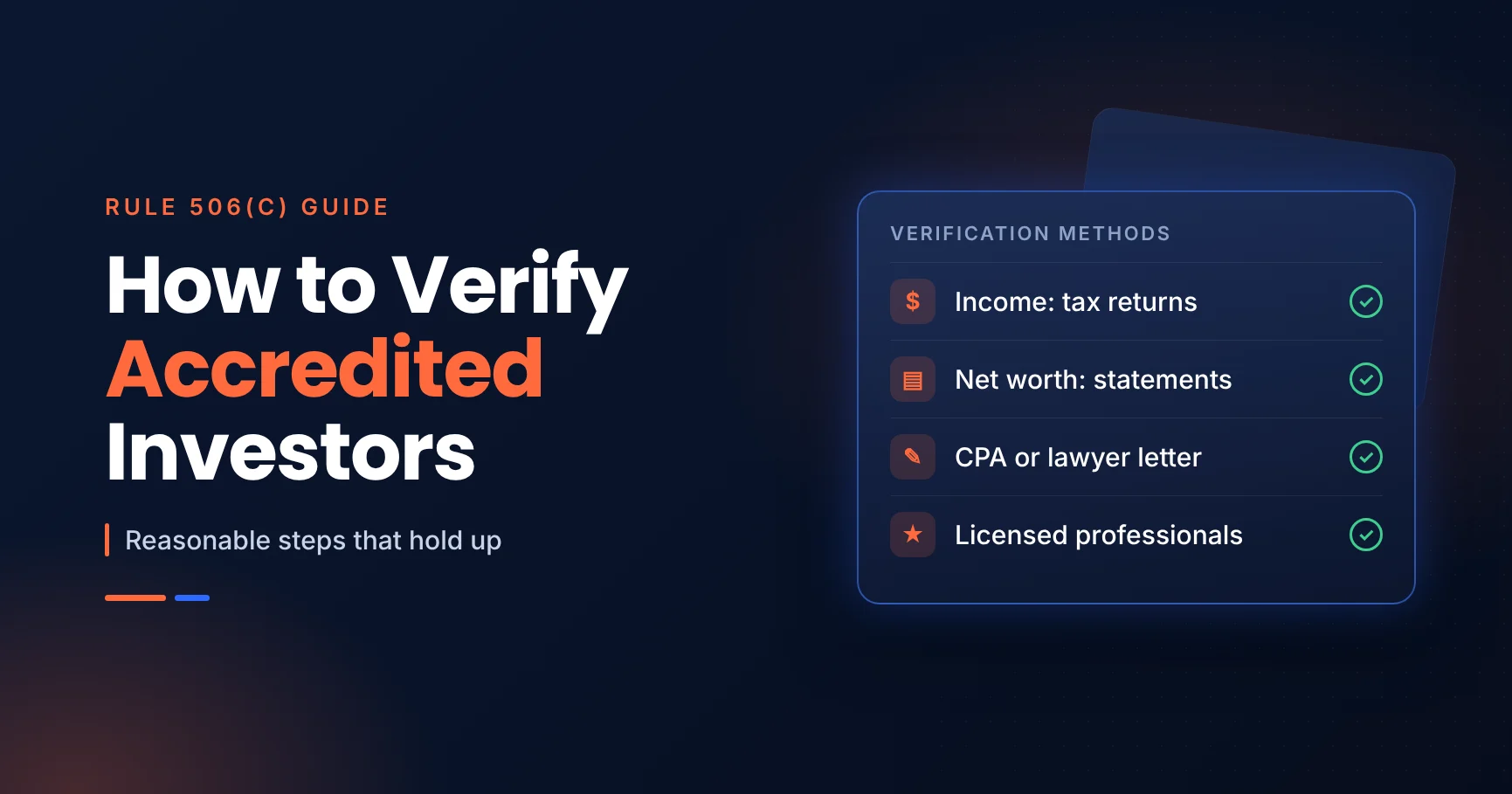
To verify accredited investors under Rule 506(c), you must take reasonable steps to confirm that each investor meets the SEC's accredited investor definition before they invest, and keep a record of what you did. The SEC accepts a flexible, facts-based approach and also lists specific methods, including reviewing tax forms, reviewing asset and liability statements, and relying on a letter from a CPA, attorney, broker-dealer or registered investment adviser.
Verification is the price of public marketing. If you are raising under Rule 506(b) and not advertising, you need a reasonable belief that investors are accredited, which usually means a questionnaire. If you are using Rule 506(c), you need more. Our guide to Rule 506(b) vs 506(c) explains when each applies.
Who Is an Accredited Investor?
The definition is in Rule 501(a) of Regulation D. The SEC summarizes the main tests for individuals:
- Income: more than $200,000 (or $300,000 with a spouse or spousal equivalent) in each of the prior two years, with a reasonable expectation of the same for the current year.
- Net worth: more than $1 million, alone or with a spouse or spousal equivalent, excluding the value of the primary residence.
- Professional credentials: holding a Series 7, Series 65 or Series 82 license in good standing.
Other individual categories include directors and executive officers of the company selling the securities, and "knowledgeable employees" of a private fund for investments in that fund.
Many entities qualify too. According to the SEC, these include entities owning investments in excess of $5 million; corporations, partnerships, LLCs, trusts and certain other entities with assets over $5 million; and entities in which all equity owners are accredited. Banks, registered broker-dealers, investment advisers and similar institutions qualify by type.
Possible changes ahead. On September 30, 2026, the SEC requested comment on whether to recognize more credentials, such as passing a FINRA-developed accredited investor exam, the CFA charter, the CFP certification and a U.S. CPA license, as qualifying individuals. Those are proposals, not rules. We will update this guide if the SEC adopts them.
What "Reasonable Steps to Verify" Means
Rule 506(c) does not prescribe one method. The SEC explains that it is a principles-based standard: the company must make an objective determination of whether its steps are reasonable given the facts of each investor and offering. The SEC lists factors to weigh:
- The type of investor, and which accredited category they claim.
- What you already know about them. A long-time investor you have verified before is different from a stranger who clicked an ad.
- How you found them and the offering terms. An investor reached through a public post needs more checking than one introduced by a fund you trust. A high minimum investment can also support a reasonable belief.
Self-certification alone, such as a checkbox saying "I am accredited", is generally not enough under 506(c).
The SEC's Listed Verification Methods
The rule also includes a non-exclusive list of methods that are deemed to satisfy the requirement for individuals. According to the SEC's compliance guide:
| Method | What you review |
|---|---|
| Income | IRS forms that report income for the two most recent years, such as Form W-2, Form 1099, Schedule K-1 or a filed Form 1040, plus a written representation that the investor expects to reach the threshold this year |
| Net worth | Asset documents dated within the prior three months (bank, brokerage and other securities statements, certificates of deposit, tax assessments, independent appraisals) and a consumer credit report from a nationwide agency for liabilities, plus a written representation that all liabilities are disclosed |
| Third-party confirmation | A written confirmation from a registered broker-dealer, SEC-registered investment adviser, licensed attorney or CPA that they took reasonable steps to verify the investor within the last three months |
| Existing investors | For an investor who invested in your earlier 506(b) offering as an accredited investor before September 23, 2013, a certification at the time of the new sale |
The SEC staff have confirmed these methods are non-exclusive and non-mandatory: you can apply the reasonableness standard directly instead.
Third-party letters are the most common route for startups. Investors often prefer to share tax returns with their own CPA or lawyer rather than the company. Online verification services work the same way: a licensed professional reviews the documents and issues a letter to you.
The 2025 High-Minimum-Investment Position
In March 2025, SEC staff issued a no-action letter to Latham & Watkins that gives companies another path. The staff said it would not object if an issuer treats these steps as reasonable verification:
- A high minimum investment: at least $200,000 for individuals or $1 million for entities, paid in cash and not financed by a third party. The letter sets out further conditions for entities that qualify only because their owners are accredited.
- Written representations from the investor that they are accredited and that the minimum investment is not financed by a third party for the purpose of investing.
- No actual knowledge of facts showing the investor is not accredited or that the money is financed.
This matters most for funds and larger rounds where every check is above those amounts. For a seed round with smaller checks, the traditional methods still apply. A no-action letter reflects the staff's view, not a rule, so have your lawyer confirm the details before you rely on it.
A Verification Checklist for Founders
- Decide your method before you market. Choose documents, third-party letters, a verification service or the high-minimum approach, with your lawyer.
- Put it in your offering documents. Tell investors up front what you will ask for.
- Verify before you accept money. Verification must happen before the sale.
- Use current documents. Asset statements and third-party letters should be recent, generally within three months.
- Keep a record for each investor. Store what you reviewed or the letter you received, the date and who checked it, securely and with limited access. Investor financial documents are sensitive, so keep them in a secure data room rather than email.
- Re-verify for new offerings. Investors' circumstances change.
- File your Form D on time. Check Rule 506(c) in Item 6, within 15 days of the first sale. See how to file a Form D and our deadline calculator.
Common Mistakes
- Using a checkbox under 506(c). It is the most common gap.
- Verifying after the money arrives. Verification belongs before the sale.
- Counting the home in net worth. The primary residence is excluded.
- Mixing up the exemptions. If you marketed publicly, a 506(b) questionnaire approach may not be available. Our exemption guide walks through the options.
Before you choose, it helps to see how often other companies use 506(c). In the 12 months to November 22, 2026, 16.4% of company offerings and 8.2% of fund offerings on Form D relied on Rule 506(c), according to our weekly Private Raise Report.
Free weekly reportPrivate Raise Report: what US companies raised this weekEvery SEC Form D filing, turned into raise sizes by industry, state and exemption.See this week’s numbers →