

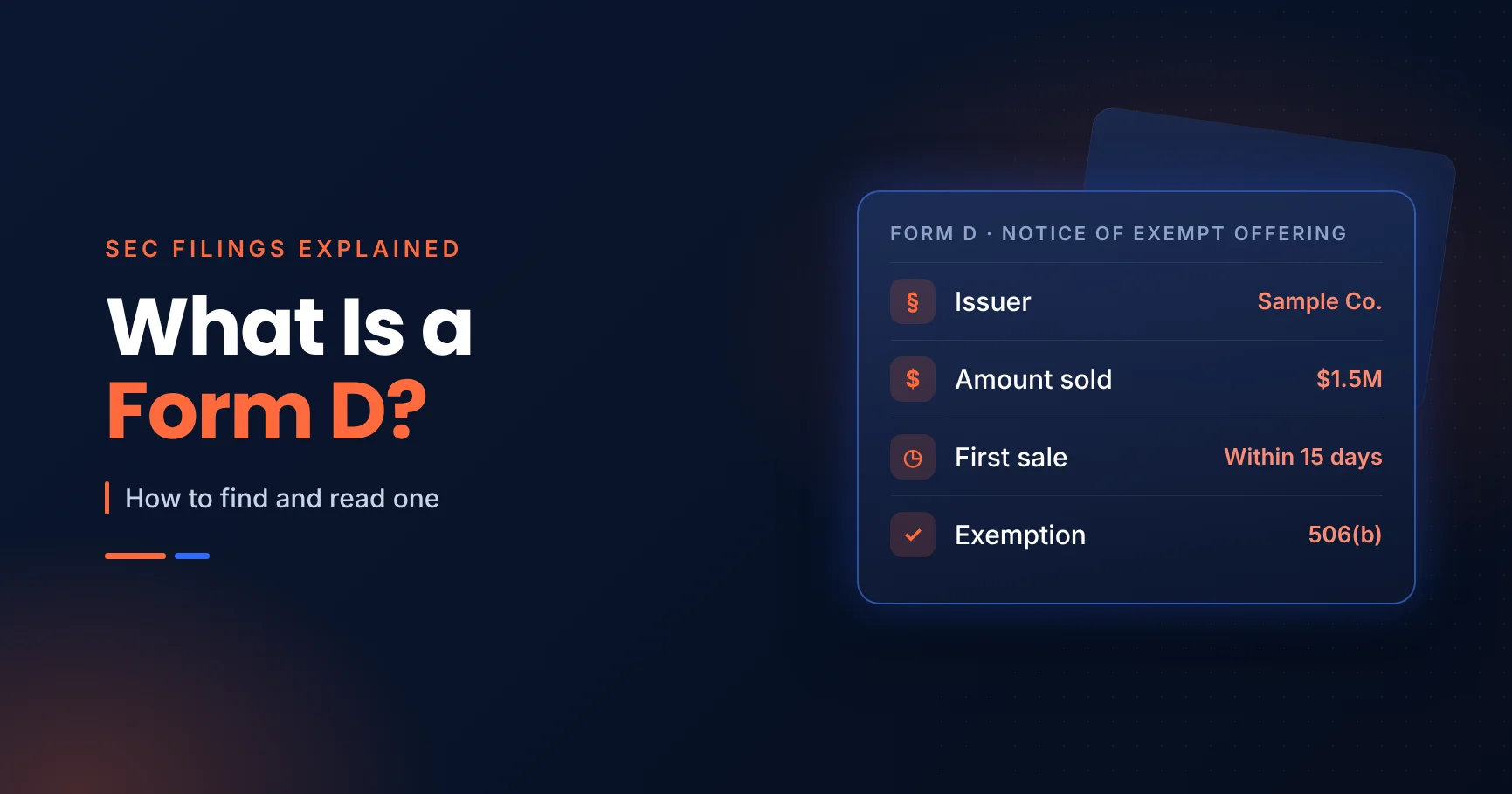
A Form D is a notice that a company or fund files with the SEC after it sells securities without registering them. Companies relying on Rule 504 or Rule 506 of Regulation D, or Section 4(a)(5) of the Securities Act, must file it within 15 days after the first sale. Every Form D is public on SEC EDGAR, which makes it one of the few free sources of data on private fundraising.
This guide explains what a Form D shows, how to find any company's filing, how to read each item and what the data cannot tell you. If you need to file one yourself, see our step-by-step guide on how to file a Form D.
What a Form D Is, and What It Is Not
According to the SEC, Form D is a notice of an exempt offering of securities required by Regulation D, filed on EDGAR, and publicly available once filed. The SEC does not charge a fee to file it.
Three things a Form D is not:
- Not an approval. The SEC does not review or endorse the offering. The information is reported by the filer and is not verified by the SEC.
- Not an offer to sell. It is a notice after the fact, not a pitch or a prospectus.
- Not a full picture. It does not include valuation, the cap table, terms, financial statements or the names of investors.
Be careful when anyone presents a Form D as proof that an investment is legitimate. It only shows that the company filed a notice. Our guide to startup investment scams covers this tactic.
How to Find a Company's Form D
- Go to SEC EDGAR. Use the EDGAR full-text search or the company search on SEC.gov.
- Search the company's legal name. Startups often file under a legal name that differs from the brand, such as "Acme Labs, Inc." rather than "Acme".
- Filter by form type D. You will see the original notice (D) and any amendments (D/A).
- Open the filing. The primary document shows each item of the form in a readable layout.
Amendments are filed when an offering runs for more than a year, or when certain information changes, so the latest D/A for an offering usually has the most current numbers.
How to Read a Form D, Item by Item
The form has 16 items. These are the ones that matter most when you read one:
| Item | What it tells you | What to watch for |
|---|---|---|
| 1. Issuer's identity | Legal name, entity type, jurisdiction and year of incorporation | A recently formed entity, or a name that differs from the brand |
| 2. Principal place of business | Address and phone number | Matches the company's stated location |
| 3. Related persons | Executive officers, directors and promoters | Who runs the company; compare with LinkedIn and the pitch |
| 4. Industry group | The filer's chosen category | Self-selected, so often broad (for example "Other Technology") |
| 5. Issuer size | Revenue range, or net asset value range for funds | Most filers choose "decline to disclose" |
| 6. Exemptions claimed | Rule 506(b), 506(c), 504 or another exemption | 506(c) means the raise may be publicly marketed; see 506(b) vs 506(c) |
| 7. Type of filing | New notice or amendment, and date of first sale | When the round started |
| 9. Type of securities | Equity, debt, options, pooled fund interests and so on | A SAFE is often reported as "other" or as options or rights to acquire securities |
| 11. Minimum investment | Smallest investment accepted from an outside investor | A high minimum can suggest an institutional or larger-check round |
| 12. Sales compensation | Broker-dealers or others paid to find investors | Who helped raise the money, and in which states |
| 13. Offering and sales amounts | Total offering amount, amount sold, amount remaining | The most-read item; see the caveats below |
| 14. Investors | Number of investors so far, and how many are non-accredited | Non-accredited investors are only allowed under 506(b) and 504 |
| 16. Use of proceeds | Amounts paid to executive officers, directors or promoters | Large payments to insiders deserve questions |
The full form and instructions are on SEC.gov.
What Form D Data Can and Cannot Tell You
Form D is good for spotting who is raising, roughly how much and through which exemption. It is weaker for precise round sizes:
- "Amount sold" is a running total at the time of filing. A company that files after its first close may show only part of the round, and may not amend later.
- "Total offering amount" can be a ceiling, not a target. Funds especially often mark it as indefinite.
- Not every raise files. Some companies file late or not at all, and rounds under Regulation Crowdfunding or Regulation A use other forms.
- Numbers are self-reported. Neither the SEC nor anyone else checks them.
That is why we treat Form D data as a market signal, not a valuation tool. In the 12 months to November 22, 2026, the median amount sold reported by operating companies was $1,000,000, and $4.0 million for pooled funds, across 58,513 offerings, according to our weekly Private Raise Report.
How Founders and Investors Use Form D Data
- Founders benchmark what similar companies raised before setting a target. Our free raise benchmarks tool gives medians by industry and state from every Form D filed in the last 90 days.
- Investors research a company's history: earlier rounds, officers and whether it used a broker.
- Fund managers track new funds and competitors launching in their market.
- Journalists and researchers follow fundraising trends by state and sector.
For a weekly roundup of new funds and notable raises, see our weekly digest.
Free weekly reportPrivate Raise Report: what US companies raised this weekEvery SEC Form D filing, turned into raise sizes by industry, state and exemption.See this week’s numbers →