

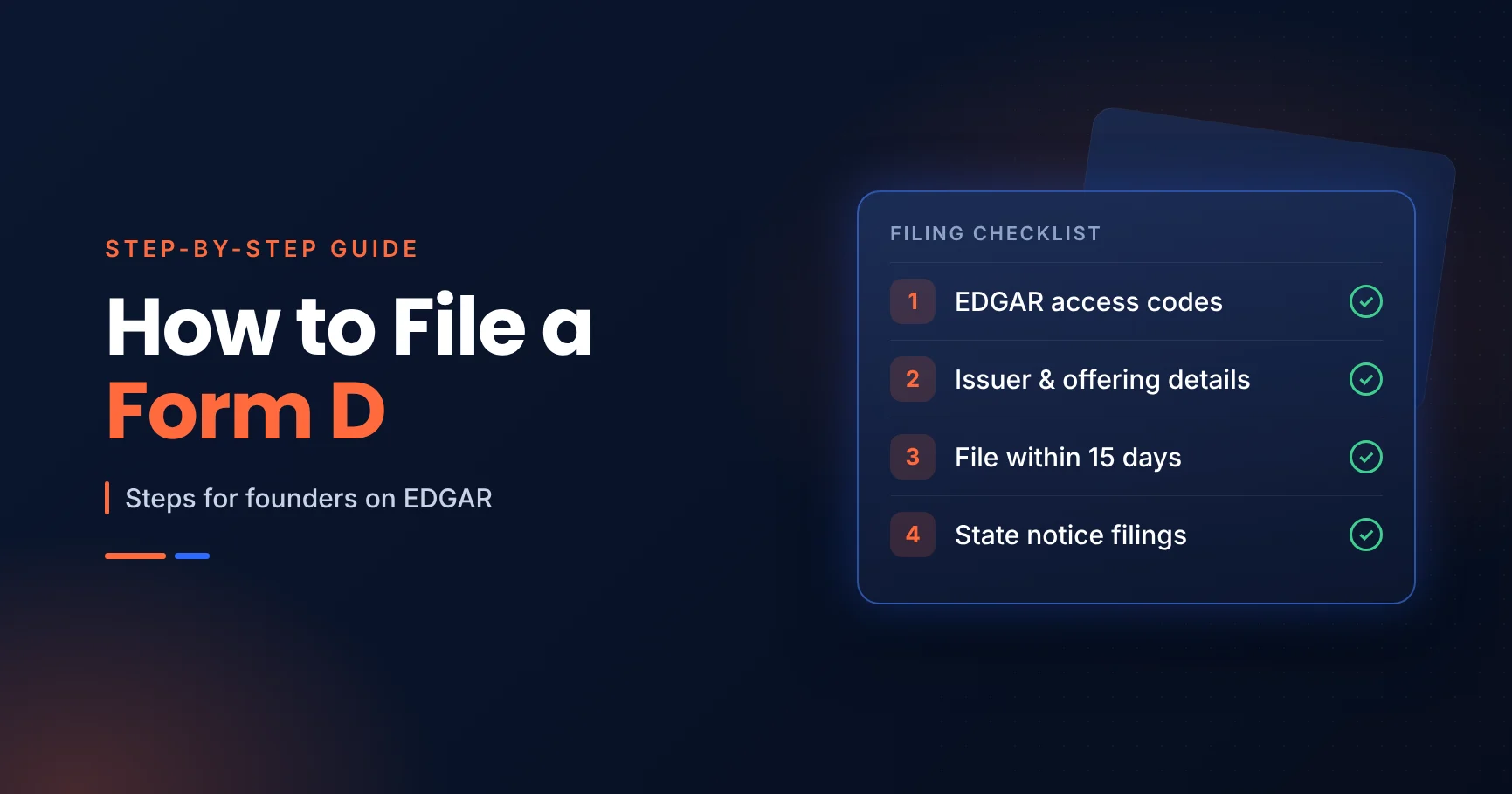
To file a Form D, get access to the SEC's EDGAR system, fill in the online Form D with your company's details and the offering, and submit it within 15 days after the first sale of securities in the offering. Then make any notice filings the states where your investors live require, and amend the form at least once a year while the offering continues.
Form D is a short notice, not a registration statement. It tells the SEC that you sold securities without registering them, relying on an exemption in Regulation D. The SEC does not review or approve it. But it is public, it is permanent, and it records which exemption you claimed, so it is worth getting right.
This guide is for founders and fund managers filing their first Form D. It covers who has to file, the deadline, getting EDGAR access, what each part of the form asks, state filings, amendments and the mistakes we see most.
Who Has to File a Form D?
You have to file a Form D if you sell securities without registration under Rule 504 or Rule 506 of Regulation D, or under Section 4(a)(5) of the Securities Act. According to the SEC, the notice is required of companies that have sold securities without registration in an offering made under those rules.
That covers most startup rounds and most private fund raises in the United States. A priced seed round, a SAFE round or a fund's capital raise relying on Rule 506(b) or 506(c) all need a Form D. If you are not sure which exemption your raise relies on, our free exemption guide walks through Regulation D, Regulation CF and Regulation A.
Many companies file. In the 12 months to November 22, 2026, 20,043 operating companies and 38,470 pooled funds filed a Form D or an amendment for an offering, according to our weekly Private Raise Report, built from every Form D on EDGAR.
When Is a Form D Due?
A Form D is due within 15 days after the first sale of securities. The SEC defines the date of first sale as the date on which the first investor is irrevocably contractually committed to invest, and if the due date falls on a Saturday, Sunday or holiday, it moves to the next business day.
Two practical points:
- The clock starts with the commitment, not the money. A signed subscription agreement or SAFE can start it before any funds arrive.
- One offering, one filing. You file once per offering, not once per investor. Later closings in the same offering are covered by amendments when they are required.
Our free Form D deadline calculator gives you the date from your first-sale date, and lets you add it to your calendar.
Step 1: Get EDGAR Access
Before you can file, your company needs an EDGAR account. The SEC does not charge any fee to open or maintain one, according to the SEC.
Access changed in 2025. Under the SEC's EDGAR Next rules, compliance has been required since September 15, 2025: individuals acting for a filer must sign in with Login.gov credentials and complete multifactor authentication. New filers apply for access by submitting Form ID on the EDGAR Filer Management website.
What that means in practice:
- Each person who will file creates a Login.gov account in their own name.
- The company submits Form ID on EDGAR Filer Management, naming one or more account administrators.
- SEC staff review the application. Allow several business days; the SEC has warned that reviews can take longer in busy periods.
- Once granted, an account administrator authorizes the people (or the law firm) who will file for the company.
Apply as soon as you know you will raise, not after your first close. Waiting for EDGAR access is the most common reason first-time filers run late.
Step 2: Gather What the Form Asks For
Form D is filed online through EDGAR. It asks for 16 items. Have these ready before you start:
| What the form asks | What to have ready |
|---|---|
| Issuer identity and contact (Items 1–2) | Legal name, entity type, jurisdiction and year of incorporation, principal place of business, phone number |
| Related persons (Item 3) | Names and addresses of executive officers, directors and promoters |
| Industry and size (Items 4–5) | The industry group that fits best; revenue range (or net asset value range for funds), or "decline to disclose" |
| Exemption claimed (Item 6) | Rule 506(b), 506(c), 504 or another exemption, as your lawyer advised |
| Type of filing and duration (Items 7–8) | New notice or amendment; whether the offering is expected to last more than one year |
| Securities and terms (Items 9–11) | Type of securities (equity, debt, options, pooled fund interests and so on) and the minimum investment accepted |
| Sales compensation (Item 12) | Anyone paid for finding investors, such as a broker-dealer, and the states where they solicit |
| Offering and sales amounts (Item 13) | Total offering amount (or "indefinite"), amount sold so far, amount remaining |
| Investors (Item 14) | Number of investors so far, and how many are not accredited |
| Commissions, fees and use of proceeds (Items 15–16) | Sales commissions and finders' fees; any proceeds paid to officers, directors or promoters |
The full form and its instructions are on SEC.gov. Item 6 matters most: the exemption you check is the one you have to comply with. If you plan to market the raise publicly, that is Rule 506(c), not 506(b). Our guide to Rule 506(b) vs 506(c) explains the difference.
Step 3: File on EDGAR
Sign in to EDGAR with your Login.gov credentials, open the online Form D, complete each item, review it and submit. EDGAR returns a confirmation and an accession number; keep both. Your filing then appears publicly on EDGAR, usually the same day.
Before you submit, check three things:
- The exemption in Item 6 matches how you are raising. Public posts, a public pitch page or cold outreach to strangers generally point to 506(c).
- Amounts in Item 13 match your records. "Amount sold" is what investors have committed so far, not your target.
- Item 12 is accurate. If you pay anyone to find investors, they generally need to be a registered broker-dealer, and the form asks you to name them.
Step 4: Make State Notice Filings
Filing with the SEC is not the end. Securities sold under Rule 506 are "covered securities", so states cannot require you to register them, but most states still require a notice filing and a fee when you sell to investors in that state. The SEC notes that a company must comply with state securities laws in the states where securities are offered or sold.
Most states accept these filings through NASAA's Electronic Filing Depository, where you can submit the notice and pay the fee for several states at once. Deadlines and fees vary by state, so check each state where you have an investor, ideally with your lawyer, as soon as each investor commits.
Step 5: Amend When Required
According to the SEC, an amendment to Form D is required annually if the offering is ongoing for more than 12 months, or if certain information changes. Common triggers include a material mistake in the original filing or a material change in the information it reports, such as a large increase in the offering amount. Some changes, like the amount sold so far, do not by themselves require an amendment.
Set a calendar reminder for the anniversary of your filing if the round may stay open. An open SAFE round can run for a long time.
Mistakes We See Most Often
- Starting EDGAR access too late. Apply for access when you start fundraising, not after your first check.
- Checking 506(b) while marketing the round publicly. If you have posted about the raise or pitched publicly, talk to your lawyer about whether 506(c) applies.
- Forgetting the states. The SEC filing does not cover state notice filings.
- Paying an unregistered finder. Item 12 asks about sales compensation; paying someone who is not a registered broker-dealer to find investors can create problems for the offering.
- Treating the form as private. Everything on a Form D is public. Investors, competitors and journalists read them; we built our raise benchmarks from them.
How Founders Use Form D Data
Because every Form D is public, the filings are a free benchmark. Before you set your raise, you can see what companies in your industry and state actually raised. Our raise benchmarks tool turns every Form D filed in the last 90 days into medians by industry and state, and our guide to reading a Form D shows how to look up any company's filing.
Free weekly reportPrivate Raise Report: what US companies raised this weekEvery SEC Form D filing, turned into raise sizes by industry, state and exemption.See this week’s numbers →