
Startup Data Room Built for Fundraising
Upload your documents, gate access behind an automatic NDA, and share your startup data room with investors in minutes. Free to get started — no credit card required.
Request Your Onboarding Call
Our team will personally walk you through the platform and get your free data room set up.
Everything Your Fundraise Needs — In One Secure Place
Automatic NDA Gating on Every Data Room
Every startup data room on Alpha Hub requires investors to sign an NDA before they can access your documents. The process is fully automatic — no chasing signatures, no manual follow-up. Your materials are protected from the moment you share your link.
Upload and Organize Your Fundraising Documents
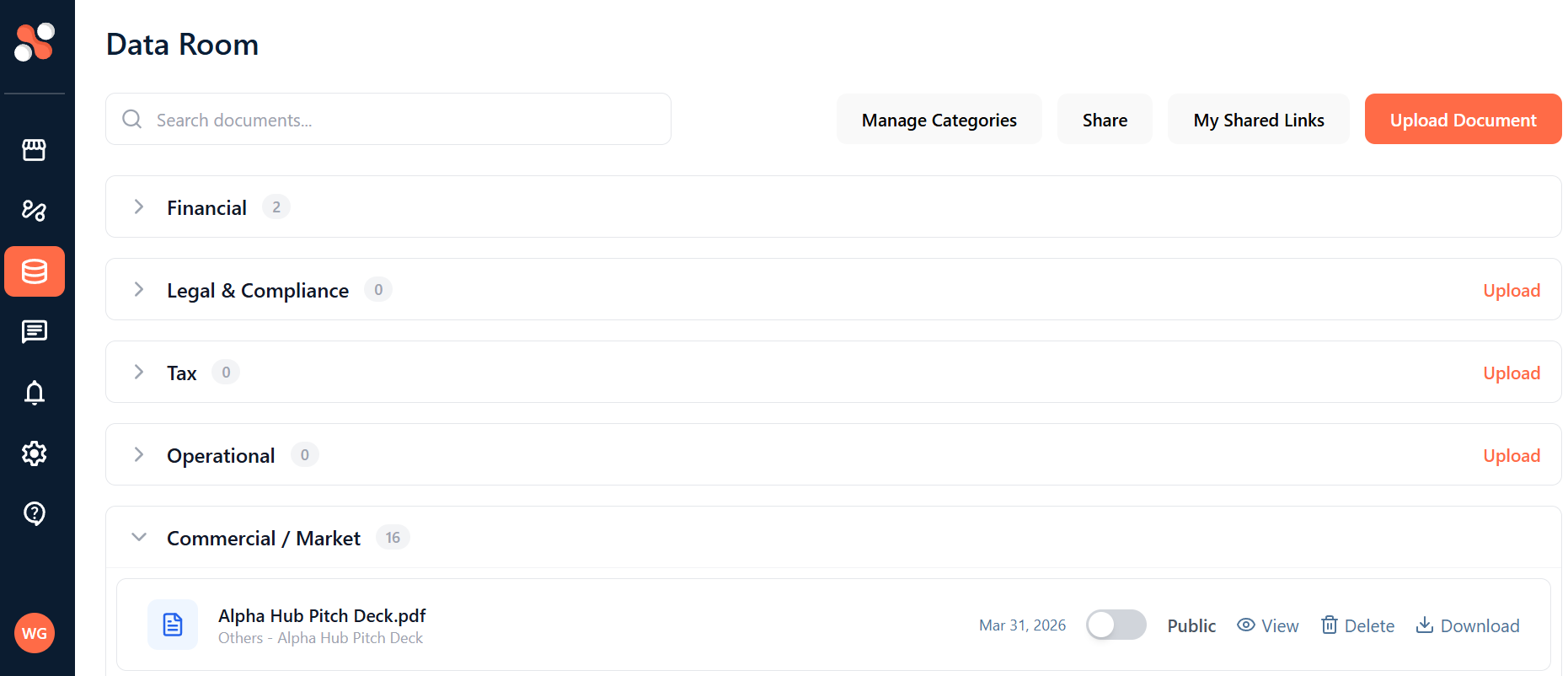
Upload PDFs, financial models, cap tables, pitch decks, and supporting materials. Organize everything into categories like Financial, Legal, and Company Overview so investors navigate your data room with confidence, not confusion.
Share the Right Documents With the Right Investors
Generate a custom shareable link that gives investors access to exactly what you want them to see. Set individual documents as public or private, revoke access at any time, and maintain full control over your materials throughout the fundraising process.
Get Discovered on a Growing Investor Marketplace
Set documents to public to make your startup data room visible to investors actively browsing the Alpha Hub marketplace. Instead of cold outreach to investors who may not be looking, you become discoverable to the ones who are.
Set Up Your Startup Data Room in Three Steps
Create Your Free Account
Sign up as an issuer in minutes. No technical setup, no credit card. Your account is ready the moment you confirm your email.
Upload Your Documents and Organize by Category
Add your pitch deck, financial model, cap table, legal documents, and any supporting materials. Create categories that match how investors think: Financial, Legal, Company Overview, and Product.
Share Your Link — Investors Sign the NDA First
Send one secure link to any investor. They sign your NDA automatically before gaining access. You get notified the moment an investor accepts your NDA, so you always know when someone is actively reviewing your materials.
The Right Startup Data Room at Every Stage of Your Raise
At the pre-seed stage, your data room does not need to be exhaustive — it needs to be organized. Investors at this stage are betting on founders and ideas, not audited financials. A pitch deck, a one-pager, your founding team bios, and a basic financial model are enough to open a serious conversation. Alpha Hub lets you get this in front of investors on day one, free.
Seed-stage investors expect more depth. Your data room should include a detailed financial model, cap table, incorporation documents, key contracts, and early traction data. This is the stage where organization signals maturity. A well-structured seed data room on Alpha Hub tells investors you understand the process and are ready to be scrutinized.
By Series A, institutional investors are conducting real due diligence. Your data room needs to be complete, current, and clean. Legal documents, audited financials, customer references, IP assignments, board minutes, and a full cap table history are all expected. Alpha Hub scales with your raise so the same platform that got you through seed handles the demands of an institutional process.
Alpha Hub vs. Other Startup Data Room Options
| Feature | Alpha Hub | Google Drive | DocSend | Papermark | Peony |
|---|---|---|---|---|---|
| Free tier available | Always free tier | Free | Paid only | Free tier | Free tier |
| Automatic NDA gating | On by default, free | None | Advanced plan only | Paid plans only | Paid plans only |
| Granular access controls | Full control | Anyone with link | Included | Included | Included |
| Investor marketplace access | None | None | None | None | |
| Deal flow and CRM | None | None | None | None | |
| Built for fundraising (not M&A) | Fundraising-first | General use | Partial | Partial | Partial |
What Is a Startup Data Room?
A startup data room is a secure, organized virtual workspace where founders store and share the documents investors need to evaluate a company during fundraising. It is where your pitch deck, financials, legal documents, and supporting materials live — accessible to the right investors, protected from everyone else.
Why your startup data room matters more than most founders realize
Most founders treat the data room as an afterthought — something you pull together after an investor asks for it. That approach costs you momentum at the worst possible time. The moment a VC or angel expresses interest, the fundraising process accelerates. If you are scrambling to find documents, renaming files, and emailing attachments at that point, you are signaling exactly the kind of disorganization investors are trying to screen out. A startup data room built before your outreach begins means you can respond to investor interest in minutes, not days. It also forces a useful internal audit: assembling your data room reveals gaps in your documentation, financial model, or legal structure that are far better addressed before an investor finds them.
If you are actively raising capital, the Alpha Hub fundraising data room is built specifically for that workflow.
Why NDA gating matters for founders
Most founders share sensitive financial documents over email with no protection at all. Competitor-sensitive metrics, cap table details, and financial projections end up in inboxes with no control over where they go next. On Alpha Hub, every startup data room requires investors to sign an NDA before they can view a single document. The signature happens automatically within the platform. You never have to chase it, and you always have a record of who signed and when.
What to include in your startup data room
The documents investors expect vary by stage, but the core categories are consistent across pre-seed through Series A. A well-organized startup data room covers five areas:
- Financial documents: profit and loss statements, financial model, cash flow projections, and burn rate
- Legal documents: incorporation papers, cap table, shareholder agreements, and any existing term sheets or SAFEs
- Company overview: pitch deck, executive team bios, and a one-pager if available
- Product and market: product roadmap, market research, and customer validation or traction data
- Operational documents: org chart, key contracts, and intellectual property documentation
The goal is not to include everything your company has ever produced. A curated data room that tells a coherent story is more effective than a document dump. For a stage-by-stage breakdown of exactly what to include, see our full startup data room checklist for investors.
When should a startup create a data room?
A startup should create its data room before beginning investor outreach, not after receiving interest. The right time is before your first email goes out, not after your first yes comes in. Creating it early gives you a document you can refine over time, a record of what you shared with each investor, and the ability to respond instantly when momentum is on your side. If you are waiting for an investor to ask for a data room before building one, you are already behind.
What is the difference between a startup data room and a pitch deck?
A startup data room and a pitch deck serve different purposes at different moments in the fundraising process. Your pitch deck is what gets an investor interested — a narrative document designed to generate a meeting. Your data room is what converts that interest into a term sheet. It is the evidence behind the story your pitch deck tells. The pitch deck comes first. The data room is what investors access once they are ready to go deeper. On Alpha Hub, both live in the same platform: your pitch deck sits in your data room alongside the financials and legal documents that back it up.