

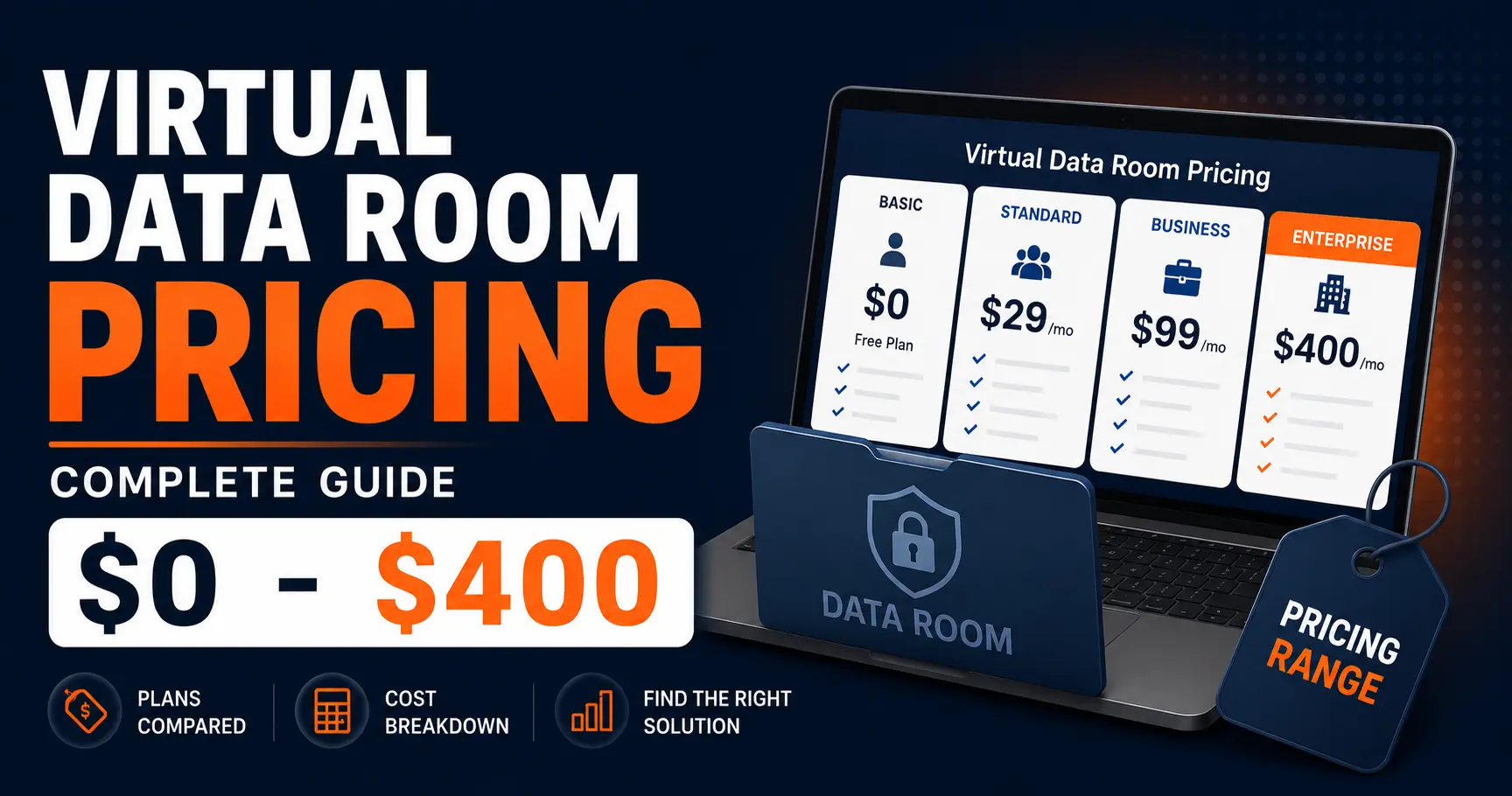
For most startups and founders, virtual data room pricing falls between $0 and $400 per month. That range covers free tools built specifically for capital raising all the way through modern flat-rate platforms with solid feature sets. The $200,000 figure you will see in other pricing guides is real, but it reflects Datasite and Intralinks contracts for nine-figure M&A transactions. If you are raising a seed round or a Series A, that number has nothing to do with you.
Here is how the most commonly evaluated providers compare at a glance, including who each one is actually built for:
| Provider | Starting Price | Best For |
|---|---|---|
| Alpha Hub | Free (limited documents — then $9.99/month) | Founders raising capital |
| Peony | Free (single share links only, 3-day link expiry — then $30/month) | Boutique M&A, lean fundraising teams |
| DocSend | $15 per user per month | Pitch deck sharing, early-stage fundraising |
| Orangedox | $75 per month | Small teams, single-deal simplicity |
| iDeals | $17.60 to $75 per user per month | Mid-market M&A, cross-border transactions |
| Intralinks | $1,000+ per month | Enterprise M&A, regulated industries |
| Datasite | ~$0.60 per page uploaded | Large M&A, investment banking, Fortune 1000 |
I spent several weeks researching the data room market while building out the competitive landscape for Alpha Hub, alongside colleagues with firsthand M&A advisory and startup investing experience. Most of what I found was pricing infrastructure designed for investment bankers and very little designed for founders. This guide covers the full picture, but filters it for the audience it is actually relevant to.
How Much Does a Virtual Data Room Cost?
A virtual data room costs anywhere from $0 per month to over $200,000 for a single enterprise transaction, depending on the provider, pricing model, deal size, and how long your deal runs.
For most companies outside of large institutional M&A, the realistic range is much narrower. Modern flat-rate platforms typically run from $75 to $500 per month. Mid-market platforms like iDeals generally land between $2,000 and $4,000 per month once you account for your full team size. Enterprise providers like Datasite and Intralinks operate in the $5,000 to $15,000+ per month range for mid-market deals, with large transactions regularly exceeding that.
At the other end of the spectrum, free tiers now exist at several providers, including Alpha Hub, where the data room is available at no cost for founders getting started.
The reason the range is so extreme comes down to four distinct billing models that different providers use, and understanding those models is the key to not getting caught off guard when the invoice arrives.
What Are the Four Virtual Data Room Pricing Models?
The four virtual data room pricing models are per-page, per-user, flat-rate subscription, and storage-based. Each one determines whether your monthly cost is predictable or variable, and each carries a different risk profile depending on how you run your deal.
Per-page pricing is the oldest model in the category. Providers charge between $0.40 and $0.85 per page uploaded, with multipliers for certain file types. Excel spreadsheets, for example, often convert to far more pages than their physical length suggests. A 10,000-page deal at $0.60 per page is $6,000 in upload fees alone, before a single user logs in. According to SRS Acquiom data across more than 3,800 M&A transactions, actual VDR costs exceed initial quotes by two to ten times when per-page models are involved. That's not a typo. Two to ten times.
Per-user pricing charges a fixed monthly rate for each person with access to the room. Rates typically run from $15 to $100 per user per month depending on the platform and permission tier, with some providers pricing administrators significantly higher than viewers. This model is more predictable than per-page, but it scales fast when you have multiple investor groups or buy-side teams accessing a room at the same time.
Flat-rate subscription pricing covers a defined set of features, storage, and users for a fixed monthly or annual fee regardless of activity. It's the cleanest model for most companies and removes the variable cost risk that makes per-page pricing so dangerous. Pricing ranges from about $75 per month for basic platforms to several thousand per month for full-featured enterprise tiers.
Storage-based pricing tiers costs according to how much data you store rather than page count or user count. Some platforms layer this on top of a base subscription. For most fundraising data rooms, storage isn't the constraint, so this model is rarely the most cost-effective choice for founders working with document sets in the 50 to 200 file range.
VDR Pricing Calculator
Adjust sliders to match your deal — all estimates update live.
Estimate only. Actual costs vary significantly and exceed initial quotes by 2–10× on average (SRS Acquiom).
Based on iDeals mid-range per-user rate. Enterprise configurations require a direct quote.
Based on modern flat-rate platforms. Includes unlimited users and standard features.
Based on your inputs, the per-page model costs approximately 6× more than a flat-rate subscription over 6 months.
What Do the Major VDR Providers Charge in 2026?
The quick-reference table above covers starting prices at a glance. This section goes deeper on what each provider actually costs, what the free tier gets you where one exists, and where the pricing starts to climb.
How Much Does Alpha Hub Cost?
Alpha Hub costs nothing to start. The free tier includes multi-file sharing links that never expire, which matters when you're managing an investor pipeline over months rather than running a single contained transaction. A document limit applies on the free tier, and paid plans are offered at a price point well below the market rate for comparable platforms. Alpha Hub is built specifically for founders raising private capital, not for M&A deal teams, which shapes both the feature set and the pricing philosophy.
How Much Does Peony Cost?
Peony costs between $0 and $40 per admin per month depending on the plan. The free tier includes page-level analytics and enterprise security, but the 3-day link expiry and one-file-per-link restriction make it impractical for an active investor pipeline where you need to share a full document set and keep links live over months. The Business plan at $40 per admin per month removes those constraints and adds watermarking, NDA gating, and screenshot protection. Worth considering for lean deal teams that have already outgrown the free tier limitations.
How Much Does Orangedox Cost?
Orangedox costs between $75 and $195 per month on a flat-rate subscription with no free tier. It integrates directly with Google Drive, which makes it one of the fastest platforms to set up if your documents already live there. Document engagement is tracked down to the page level. The flat-rate model means no per-page or per-user variables, so your monthly cost is predictable regardless of activity. Best for small teams running single deals who want minimal onboarding friction.
How Much Does iDeals VDR Cost?
iDeals VDR costs between $17.60 and $75 per user per month, according to datarooms.org, with the final price depending on plan tier, number of users, and deal complexity. For a typical deal team of 20 to 30 people, that puts monthly costs somewhere in the $2,000 to $3,500 range. Enterprise configurations require a direct quote and there is no free tier. iDeals is well-regarded for multi-language support and compliance certifications across more than ten languages, which explains its position at the higher end of the mid-market range.
How Much Does Intralinks Cost?
Intralinks pricing is entirely custom and quote-based with no published flat rates. Based on third-party research and disclosed industry benchmarks, implementations typically start around $1,000 per month for smaller engagements and scale to $5,000 to $50,000 or more per month for mid-market and enterprise transactions. There is no free tier. Add-on fees for advanced features are common, and actual costs frequently exceed initial quotes. Intralinks is primarily justified for regulated industries and institutional transactions where counterparties specifically require an enterprise brand name on the data room.
How Much Does Datasite Cost?
Datasite pricing depends on the model and deal size, with no published flat rates and no free tier. For mid-market transactions, total deal costs typically run between $5,000 and $15,000 per month, with large enterprise engagements reaching $50,000 to $200,000 or more over the full deal lifecycle. Datasite carries serious brand recognition among investment banks and large law firms. For anything below the mid-market M&A bracket, the cost premium is difficult to justify on the features alone.
How Much Does Datasite Cost Per Page?
Datasite costs approximately $0.60 per page uploaded under its per-page pricing model, according to pricing research from Peony and FirmRoom, with additional fees applied to certain file types including Excel spreadsheets and multimedia files. At that rate, a 10,000-page deal generates $6,000 in upload fees before a single user logs in. Per-page pricing remains common for traditional M&A mandates at Datasite alongside newer pricing structures for certain deal types.
How Much Does DocSend Cost?
DocSend costs $15 per user per month on the standard plan, or $180 per month for the Advanced Data Rooms plan which includes three users and covers NDA gates, watermarking, and group permissions. There is no free tier. Watch the $90 per user add-on fee beyond the three users included in the base plan — it does not appear prominently in their marketing materials. DocSend was built primarily for pitch deck sharing and document tracking rather than full VDR functionality, which makes it a reasonable option for early-stage fundraising but less suitable for more complex deal processes.
What Hidden Fees Do VDR Providers Charge?
VDR providers charge hidden fees through setup costs, user tier distinctions, overage charges, and time-based extensions that rarely show up clearly in published pricing.
Setup fees are common at enterprise platforms, ranging from $500 to $2,500 before you've uploaded a single document. This typically covers onboarding support that most modern SaaS tools include by default.
User tier distinctions catch a lot of buyers off guard. At DocSend, for example, additional users on the Advanced plan cost $90 per month each beyond the three users included in the base plan. That detail is not prominently displayed on their pricing page.
Overage charges apply when you exceed the storage, page count, or user limit in your plan. Not all providers prorate these overages. Some charge the full plan rate regardless of how far over the limit you went. In deals where document volume is hard to predict upfront, this is a real financial risk.
Time-based extensions are charged when your deal runs longer than the initial contracted term, which happens constantly because deals rarely close on schedule. Some providers charge a full additional billing cycle rather than a prorated rate for a two-week extension, which can add up significantly on larger deals.
The consistent pattern here, documented by SRS Acquiom across thousands of real transactions, is that initial quotes understate final costs by two to ten times. Before you sign anything, get an all-in cost estimate in writing. Ask specifically about overage policies, extension terms, and whether external reviewers count as administrators or viewers. The difference between the headline price and the actual invoice is rarely in your favor.
Why Did VDR Pricing Get So High?
VDR pricing got so high because the category was built from the ground up for investment banks managing nine-figure M&A transactions, where a $50,000 data room is a rounding error in the deal budget.
Virtual data rooms started as replacements for physical data rooms: actual rooms in law firms where buyers sent analysts to review paper documents under supervision. The cost of running those physical spaces was genuinely high, and the first virtual alternatives were priced accordingly. Datasite, Intralinks, and the other early platforms sold exclusively into investment banking relationships, where the people approving the VDR invoice were the same people billing millions in advisory fees on the deal. Nobody negotiated VDR pricing because nobody needed to.
Per-page pricing is the clearest artifact of that era. It traces directly back to the photocopying model from physical data rooms, where you paid per page reviewed. The incremental cost of hosting a digital file in 2026 is trivially small. Per-page pricing doesn't reflect infrastructure cost. It reflects a billing habit that survived because the original buyers never pushed back on it.
That pricing architecture is still largely intact at the established enterprise platforms. Newer entrants like Peony, Orangedox, and DocSend have built subscription-based models that reflect actual SaaS economics, which is why the low end of the market looks so different from the high end.
What Changes If You're Raising Capital Instead of Running M&A?
If you're a founder raising capital rather than a banker running M&A, the pricing logic behind most VDR reviews barely applies to your situation.
The guides and roundups that dominate this space were written for deal teams managing formal acquisition processes: single transactions with defined document volumes, finite timelines, and counterparties who are already at the table. That context shapes every assumption in those guides, from the importance of brand recognition to the tolerance for per-page fees.
Capital raising looks different in almost every respect. You're running an ongoing process that can span 12 months or more, involving 100 to 200 investor conversations at various stages of interest. You're not managing one contained deal. You're managing a pipeline. Your documents change as your business evolves. And the people reviewing your data room this week might be completely different from the ones reviewing it in three months.
Your document volume is also nowhere near the scale that makes per-page pricing relevant. A well-organized fundraising data room for an early-stage company typically runs 50 to 100 files. The math that generates $200,000 invoices assumes tens of thousands of pages across multi-party M&A processes. That math doesn't apply to you.
What actually matters for a capital raising data room is whether it's easy to share, easy for investors to navigate, and gives you useful signal about who is engaged. A tool that costs $15,000 a month and was built to satisfy the compliance requirements of a cross-border acquisition isn't better for your use case. It's just expensive.
How Alpha Hub Approaches Data Room Pricing
One of the things that came up repeatedly in my research conversations with the Alpha Hub team was this: why had the pricing model for virtual data rooms not been disrupted more specifically for the capital raising use case?
The team has direct backgrounds in M&A advisory and early-stage investing. That combination shaped a clear perspective: founders raising private capital have been oversold on infrastructure built for a completely different context and a completely different buyer.
Alpha Hub's data room is currently free. That's not a watered-down entry tier designed to push you toward a $5,000 per month enterprise plan. It's genuinely free while we're in our launch period, and when paid tiers roll out, they'll be priced well below the market because the data room is one part of a broader platform built specifically for capital raising, including deal flow management and CRM tools alongside secure document sharing. The goal is to make serious capital raising infrastructure accessible at a cost that actually makes sense for founders.
If you want to see what that looks like, explore the Alpha Hub data room here.
How to Choose the Right VDR Pricing Model for Your Situation
The right virtual data room pricing model depends on your deal type, document volume, number of parties involved, and how predictable your timeline is.
For formal M&A at the mid-market level or above, a platform like iDeals or Firmex makes sense. The multi-language support, compliance certifications, and institutional track record matter when your counterparties expect a recognized platform and the deal justifies the cost.
For enterprise transactions where investment banks and law firms specifically require a brand name on the data room, Datasite remains the default. For anything below that deal size, the cost premium is hard to justify on features alone.
For founders raising private capital, a modern flat-rate platform or a free tier built for that use case covers your actual requirements at a fraction of the cost. The per-page pricing models and $2,000 per month base tiers that dominate traditional VDR reviews were built for a different buyer. You have better options.
Regardless of which provider you go with, always ask for an all-in cost estimate before signing. Confirm how overages are calculated, what happens when the deal runs long, and whether external reviewers count as administrators or viewers. The fine print is where the real cost lives.