

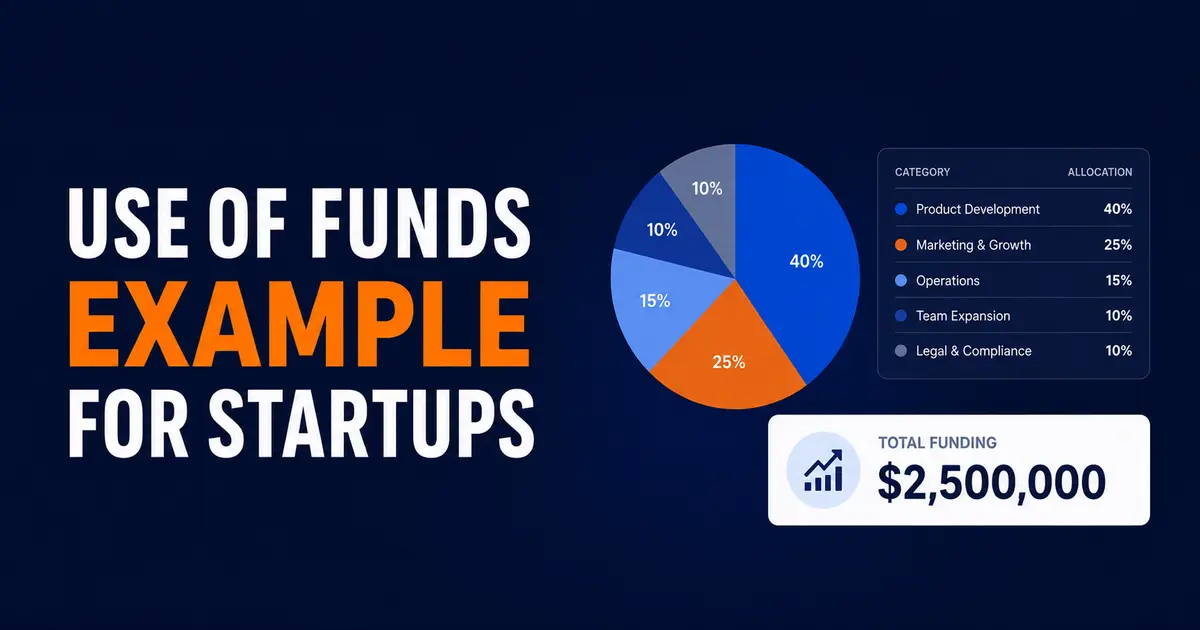
A use of funds example is a breakdown that shows investors exactly how you plan to spend the capital you raise, organized by category, with percentages, dollar figures, and the milestones each allocation will reach. A complete use of funds example for investors includes these seven sections:
- The funding amount and stage
- Personnel and hiring
- Product and technology development
- Sales, marketing, and customer acquisition
- Operations, facilities, and administration
- Monthly burn rate and runway
- Milestones the round will unlock
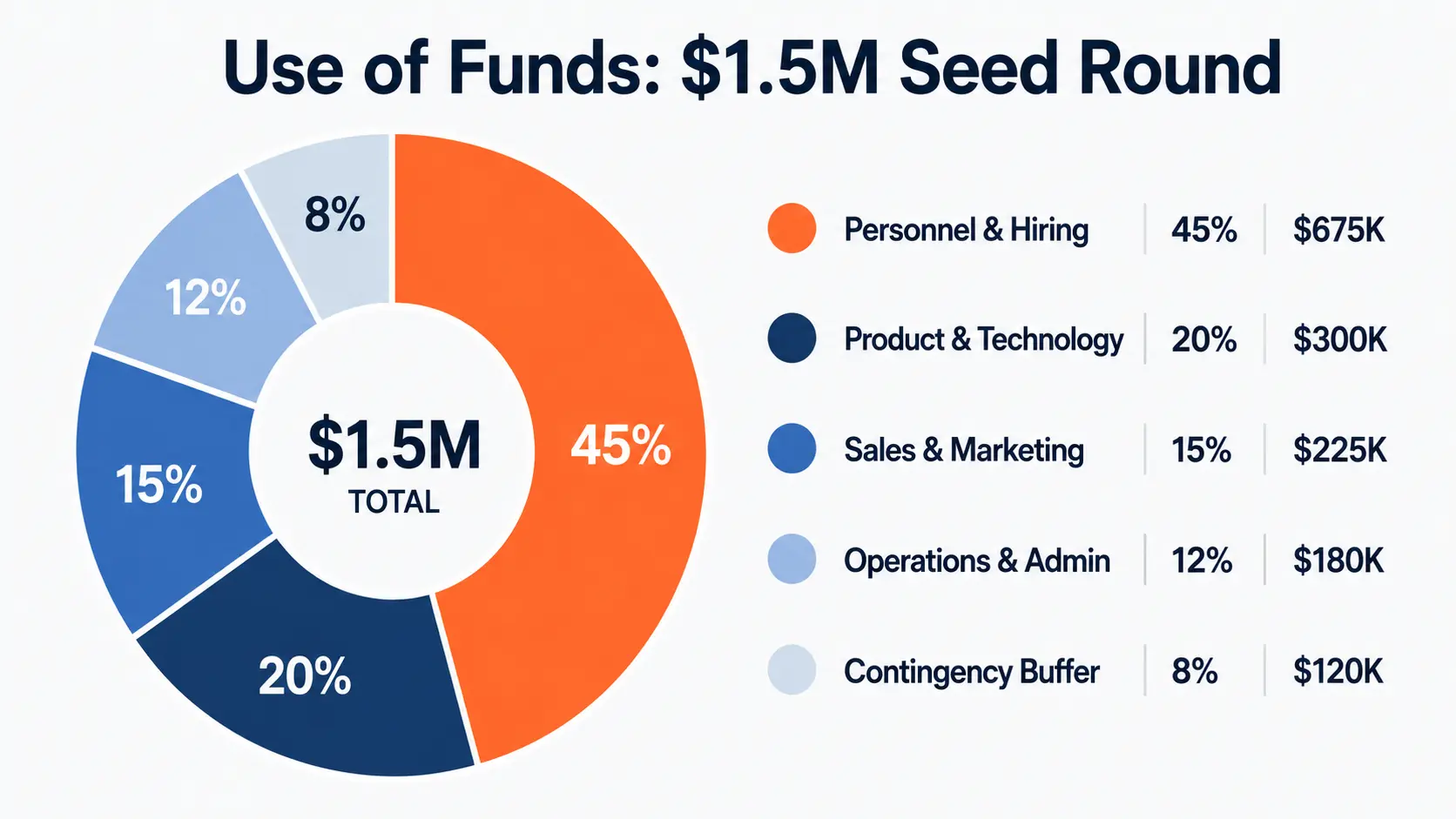
Here is what that looks like at a glance for a startup raising a $1.5 million seed round:
| Category | Allocation | Amount |
|---|---|---|
| Personnel and hiring | 45% | $675,000 |
| Product and technology | 20% | $300,000 |
| Sales and marketing | 15% | $225,000 |
| Operations, facilities, admin | 12% | $180,000 |
| Contingency buffer | 8% | $120,000 |
The use of funds is one of the most important documents in a data room at any stage. During our seed round at Alpha Hub, we originally left this document out. After a few investor meetings, we realized quickly that a use of funds was non-negotiable if we wanted to raise the round, because the founders who earn the second meeting are almost always the ones who can show, line by line, where the money goes and what it buys.
This guide walks through each of the seven sections above, in order. It is written for founders raising capital, not for the mergers and acquisitions context that most "sources and uses" content assumes, so the categories and the level of detail reflect what early-stage investors actually look for.
The Funding Amount and Stage
The first section of your use of funds is the funding amount and stage, stating clearly how much you are raising and where you sit in your fundraising journey. Investors want this answered before they read a single line item, because the amount and the stage set the context for everything that follows. A $500,000 pre-seed round and a $3 million seed round call for very different spending plans, and the reader needs that frame up front.
Be specific and be confident in the number. A precise figure like $1.5 million signals that you have done the work to know what you need, while a vague range like "$1 to 2 million" suggests you are still guessing. State the stage in plain terms: pre-seed, seed, or Series A. If the round is structured, note the instrument too, whether that is a priced equity round, a SAFE, or a convertible note, since it tells investors how their capital converts.
It also helps to tie the raise to a time horizon. Saying that $1.5 million funds roughly 18 months of runway tells an investor what the money buys in time, not just in line items. That single sentence frames the entire breakdown that follows, and it sets up the burn rate and runway section later in this document.
Worth noting: the amount you put on the page is a starting point for a conversation, not a final figure carved in stone. Founders adjust the size of a round as they learn what the market and their investors will support. State a clear number, stand behind your reasoning for it, and stay open to the discussion that follows.
Personnel and Hiring
Personnel and hiring is almost always the largest line in a seed-stage use of funds, so it carries the most weight with investors. Early-stage companies are mostly buying people, and investors want to see that your hiring plan is deliberate. On the document itself, you do not need to list every role and salary. Show personnel as a category with its allocation, then name the hiring focus that defines the round, such as building out a blockchain engineering team or making your first sales hires.
Behind that category, do the detailed work in your own model. At Alpha Hub, we built each role from a real salary estimate, using a low, medium, and high range based on market data for the location and seniority, and we loaded every salary with the full cost of employment, including payroll taxes, benefits, and any equity or bonus, because the headline number is rarely the real cost. Investors will not see that breakdown on the page, but you should have it ready for the questions that follow.
Tie the hiring focus to a reason. If the round is mostly funding engineers to ship the product that unlocks your next milestone, say so. Investors fund hiring plans that map to outcomes, and a personnel line that names its purpose reads very differently from one that simply grows.
Product and Technology Development
Product and technology development covers the money you spend building and improving what you sell. For most startups raising capital, this section includes engineering work beyond core salaries, such as contractor or agency costs, software and cloud infrastructure, data and API fees, security and compliance tooling, and any hardware you need to ship.
Keep this separate from general operations. A reader should be able to see how much of the raise goes directly into the product versus keeping the lights on. If a meaningful share of the round funds a specific build, name the build and what it delivers. For example, "$300,000 to launch version two and onboard the first cohort of paying customers" tells an investor far more than "product development."
If you are protecting intellectual property, include the legal and filing costs here or in operations, and be consistent about where they sit. The goal is a clean line between what grows the product and what simply sustains the business.
Sales, Marketing, and Customer Acquisition
Sales, marketing, and customer acquisition is where you show investors how you turn capital into growth. This section typically covers paid acquisition, content and SEO, events and partnerships, sales tools and CRM, and any go-to-market hires not already counted under personnel. Decide where sales salaries live and keep them in one place so you do not double count.
Investors scrutinize this line for discipline. The strongest use of funds ties acquisition spend to a number, such as a target cost per acquired customer or a pipeline goal, instead of a round figure with no logic behind it. Saying "$225,000 to reach 500 paying customers at a blended acquisition cost of $450" shows you understand your own economics. A bare "marketing: 15%" invites the question you do not want, which is whether you actually know how growth happens in your business.
Operations, Facilities, and Administration
Operations, facilities, and administration is the section that keeps the company running day to day. It usually includes office or coworking lease costs, legal and accounting fees, business insurance, software and subscriptions used across the company, entity setup in any jurisdictions where you operate, and travel. None of it builds the product directly, but all of it is real, and leaving it out makes your plan look naive.
Keep this section lean and specific. Investors read a bloated operations line as a discipline problem, and they read missing categories like insurance or legal as inexperience. If you operate in more than one country, the cost of setting up and maintaining each legal entity belongs here, and naming it shows you understand the actual mechanics of running the business you are pitching.
Monthly Burn Rate and Runway
Monthly burn rate and runway show how long the money lasts and what you can accomplish before you need to raise again. Your burn rate is the net cash you spend each month, and your runway is the number of months the raise gives you at that rate. Investors look at these two numbers together to judge whether the round is sized correctly for the plan.
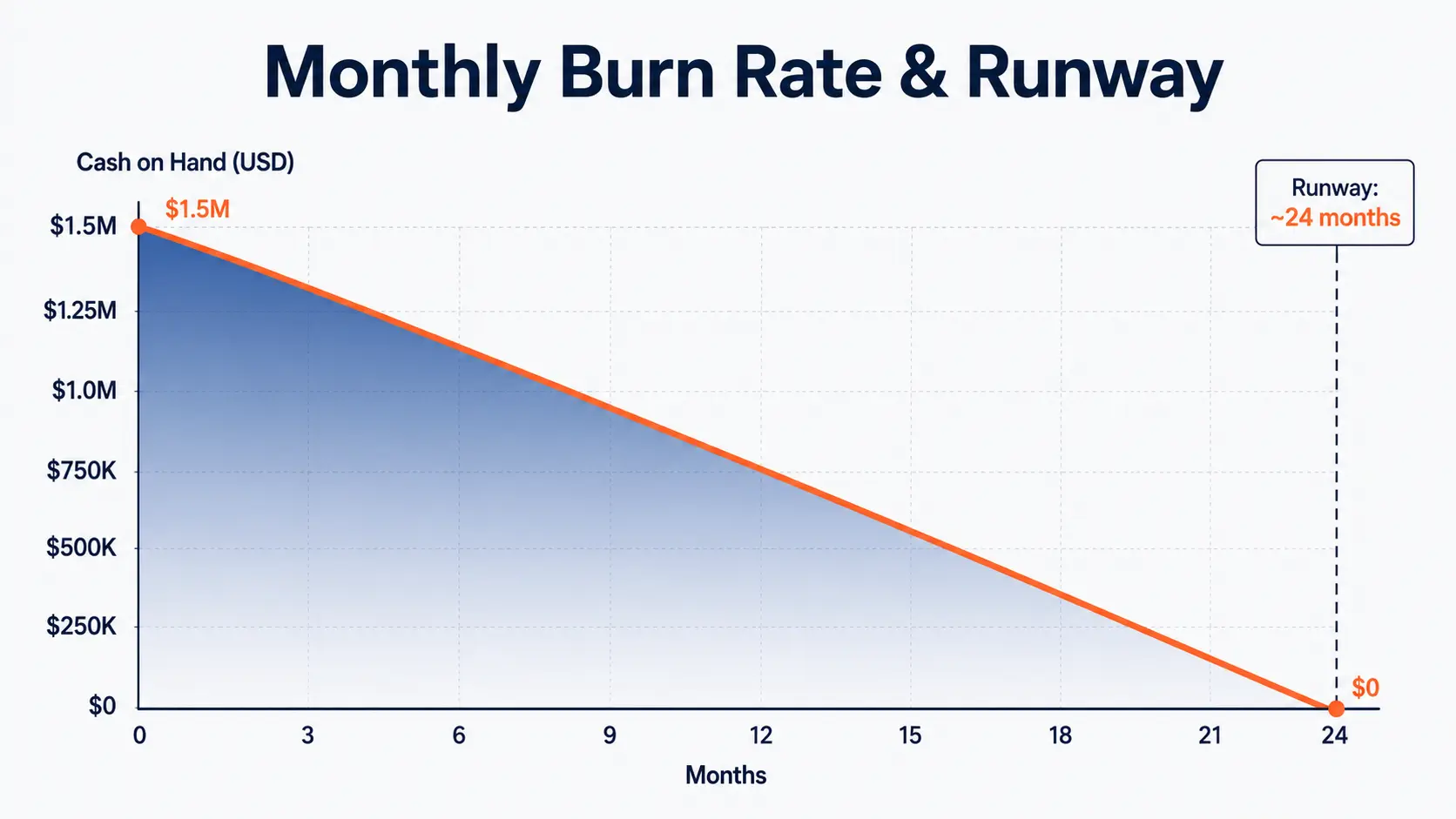
Present this as a month-by-month view rather than a single average. A simple line showing cash on hand declining over the funding period makes your burn concrete and lets an investor see exactly when you would run out without a new raise. Include your average monthly net burn as a summary figure, but let the monthly detail do the real work.
Size your runway to reach a real inflection point, not just to survive. According to Carta, the median time from seed to Series A stretched to 774 days in late 2024, roughly 84% longer than in 2021, which means a seed round needs to fund a longer road to the next milestone than founders often assume. Budgeting toward 24 months of runway, with a buffer for the raise taking longer than planned, is far more credible than a tight 12-month plan that leaves no room for the market to move slowly.
Milestones the Round Will Unlock
Milestones the round will unlock are the outcomes this capital will buy, and they are what turn a budget into a story investors believe. A use of funds that lists categories without milestones answers "where does the money go" but skips the more important question, which is "what do we get for it." Investors fund progress, so connect the spend to specific, measurable results.
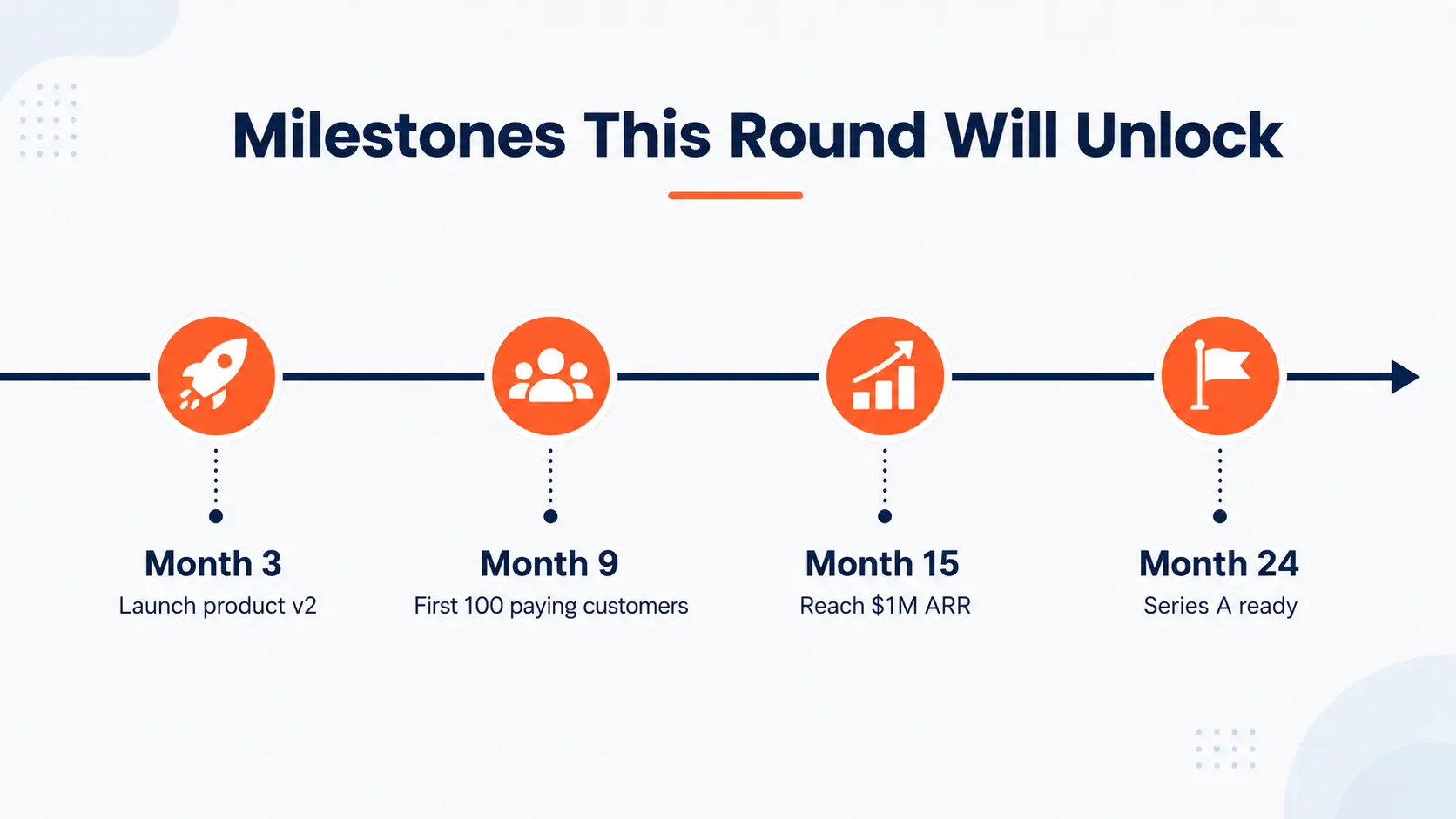
Make each milestone concrete and time-bound. Strong examples include reaching a revenue figure, shipping a product version, hitting a user or customer count, or closing a set of pilot contracts. Then link these milestones back to your next raise. The clearest use of funds tells an investor that this round funds the company to the metrics that make the next round possible, and that is the logic that gets a check written.
How to Present Your Use of Funds to Investors
To present your use of funds to investors:
- Lead with a simple visual. British Business Bank guidance recommends a pie chart showing how the funds split across areas like team hires, marketing, research and development, and production, which lets an investor grasp your priorities in seconds.
- Pair every category with both a percentage and a dollar amount. Storypitchdecks, a pitch deck consultancy, advises founders to show specific figures rather than round numbers, because a clean "33% to everything" split reads as a placeholder while a precise breakdown reads as a plan. A line that says "Product development: 40% / $600,000" gives an investor the proportion and the absolute number at once.
- Tie each allocation to a milestone, so the reader sees what the spend buys and not just where it goes.
- Keep the investor-facing version clean and hold the deeper detail in your model. Behind any good one-page use of funds sits a far larger working file, often a spreadsheet with month-by-month costs, salary assumptions, and scaling estimates. Investors do not need that full model in the room, but you should have it ready, because the founders who can answer a follow-up question with the detail behind the summary are the ones who close.
This matters more than most founders expect. SketchBubble, in its roundup of pitch deck statistics, points to research showing financials are the fourth most scrutinized section of pitch decks, so how you present this document can be the difference between a follow-up meeting and a polite pass.
Use of Funds vs. Sources and Uses of Funds
A use of funds and a sources and uses of funds statement are related but not the same thing, and founders raising capital should know the difference. A use of funds shows how you will spend the money you raise. A sources and uses of funds statement shows both sides of a transaction: where the money comes from on one side, and where it goes on the other, with the two totals matching.
You will see "sources and uses" most often in mergers, acquisitions, and leveraged buyouts, where the sources include various forms of debt and equity and the uses include the purchase price and fees. For a startup raising a seed or Series A round, the use of funds is what investors actually ask for, because the source is straightforward: it is the round you are raising. If you ever apply for a bank loan instead of equity, expect to be asked for the fuller sources and uses version, since lenders want to see your contribution and collateral alongside the spend.
Where Does the Use of Funds Belong in Your Data Room?
The use of funds belongs in your investor data room, alongside the other documents investors review once they are seriously considering the deal. The pitch deck version is the summary; the data room version can carry a little more depth, including the monthly burn detail and the assumptions behind your categories.
We learned how much investors value this document by leaving it out. When we raised our seed round at Alpha Hub, our data room did not include a use of funds at first. Several investors asked for one directly before they would move forward, which told us it was not optional. So we built it properly. We started with a detailed internal model in a spreadsheet, breaking down headcount with low, medium, and high salary ranges for every key role, plus the costs of scaling the company, things like office lease, entity setup in our jurisdictions of operation, insurance, and travel. We mapped all of it to a month-by-month view so we could see our burn rate and runway clearly.
From that working model, we built a clean investor-facing version: the key raise details, a written explanation of how we planned to use the capital, a pie chart showing allocation across categories like personnel, facilities, and technology, a line chart of net cash burn over the funding period, our runway, and the specific milestones the round would reach. The internal model gave us the confidence to answer any question; the investor-facing version gave investors a document they could actually read. We added a dedicated use of funds section to the Alpha Hub data room because of exactly this experience, and it is now part of how we think issuers should present themselves to allocators.
What else should you include in an investor data room beyond the use of funds? Quite a lot, and I have put together a full breakdown in our investor data room checklist, which walks through every document investors expect to see before they commit.
Frequently Asked Questions
A use of funds example is a sample breakdown of how a startup plans to spend the capital it raises, organized by category with percentages, dollar amounts, and the milestones each allocation will reach. It typically covers personnel, product and technology, sales and marketing, operations, and a contingency buffer, along with the burn rate and runway the round provides.
A use of funds for investors should be detailed enough to show specific categories and dollar figures, but clean enough to read in under a minute. Aim for five to seven categories on the summary version, each with a percentage and a dollar amount, and keep the deeper month-by-month detail in a working model you can share if asked. Vague categories invite hard questions, and excessive detail buries the point.
Roughly 50% to 75% of a seed round should go to salaries, depending on whether your plan leans more toward building product or going to market. Early-stage companies are mostly investing in people, so personnel is usually the single largest category. A product still in heavy development sits at the higher end of that range as you hire engineers, while a company already selling shifts more budget into sales and marketing and lands lower. There is no single correct figure, but personnel leading the breakdown is normal and expected.
Yes, you need a use of funds even for a pre-seed or SAFE round, because investors at every stage want to know how their money will be spent. The earlier the stage, the more your use of funds is judged on the logic and discipline behind it rather than precise accuracy, since plans naturally change. A clear, well-reasoned breakdown signals that you take capital seriously, which matters most when you have the least traction to show.
The use of funds goes in both your pitch deck and your data room, in two different levels of detail. The pitch deck carries a one-slide summary, usually a pie chart with categories and milestones, while the data room holds the fuller version with month-by-month burn, runway, and the assumptions behind your numbers. Investors see the summary first and ask for the detail once they are interested.