

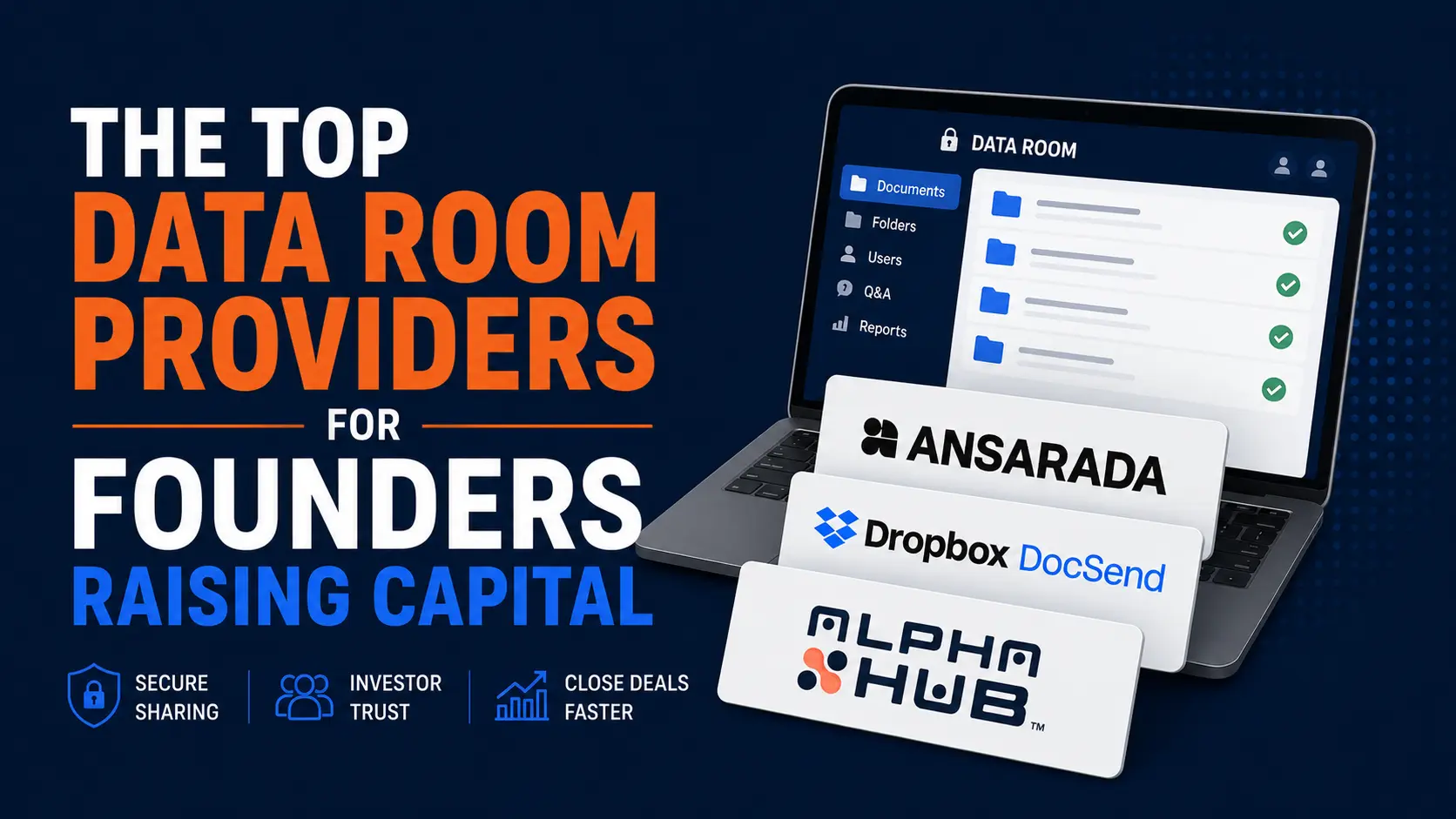
The top data room providers in 2026 include:
- Alpha Hub
- Peony
- DocSend
- Papermark
- Orangedox
- iDeals
- Ansarada
- Firmex
- Intralinks
- Datasite
Most data room guides rank these platforms based on M&A due diligence criteria: audit trail depth, Q&A workflow management, and how many Fortune 1000 investment banks trust the brand. Those are legitimate criteria if you are running a nine-figure acquisition. They are almost entirely irrelevant if you are a founder raising a seed round or a Series A.
I spent several weeks researching the data room market while building out the competitive landscape for Alpha Hub, alongside colleagues with direct backgrounds in M&A advisory and early-stage investing. The question I kept asking was not which platform handles the most complex enterprise transactions, but which platforms actually serve founders raising private capital. The answer looked very different from what most existing guides conclude.
According to Crunchbase, investors put $300 billion into 6,000 startups globally in Q1 2026 alone, with early-stage funding reaching $41.3 billion across 1,800 deals. Capital is moving, but it is moving selectively, and the bar for founder readiness has never been higher. A well-structured data room is part of that readiness. The global VDR market reached $3.4 billion in 2025 and is growing at a 19.8% CAGR through 2034, according to Fortune Business Insights. The category is maturing fast, and the gap between tools built for founders and tools built for investment bankers is getting clearer.
Here is how each of the top 10 data room providers compares when the purpose is raising capital.
1. Alpha Hub: Best Data Room for Startups Raising Capital

Alpha Hub is the best data room for startups raising capital because it is the only platform on this list that combines a full-featured data room with an integrated investor marketplace, deal flow CRM, and pipeline management in a single platform.
Most VDRs were built to solve the document security problem after investors are already at the table. Alpha Hub is built for the full capital raising workflow, from initial investor outreach through active due diligence and pipeline close. Here is what is live on the platform today:
- Single investor entry link. Every investor gets the same professional entry point regardless of how they were sourced, keeping your process organized and your brand consistent.
- NDA required before document access. Investors agree to your NDA before they can open a single file. No manual follow-up, no unsigned agreements floating around.
- Granular per-investor permissions. You control exactly what each person or investor group can see. Create different document packages for different investor tiers, from a teaser set for early conversations to a full due diligence package for serious prospects.
- Engagement analytics. Full visibility into who opened what, which documents they spent time on, and for how long. The signal that tells you which investors to call back first.
- Document category management. Organize your room by category so investors can navigate intuitively rather than hunting through a flat folder structure.
- Pipeline management in the same platform. Your entire investor pipeline lives alongside the data room. No context switching between a VDR and a separate CRM.
- Connected to a marketplace of investors. Alpha Hub's investor marketplace connects founders to allocators, family offices, and institutional investors actively looking at private capital deals. Your data room lives inside that network, not outside it.
Pricing: Free to start. Paid tiers starting at just $9.99.
Best for: Founders raising seed, Series A, or growth rounds who want their data room to be part of a complete capital raising infrastructure rather than a standalone document folder.
2. Peony: Best Free Data Room with AI-Native Analytics

Peony is the best free data room with AI-native analytics because it includes page-level engagement tracking, dynamic watermarking, and NDA gating starting at $0, with a full business tier at $40 per admin per month.
The founder built Peony after being frustrated with data room options during his own fundraise, which gives the platform a genuine startup perspective that most enterprise VDRs lack. Setup time is 3 minutes and 40 seconds from signup to a shareable link, which is the fastest I found across all platforms I tested. The free tier includes enterprise-grade encryption and page-level analytics, though links expire after three days and you are limited to one file per link on the free plan. The Business plan at $40 per admin per month removes those limitations and adds AI auto-indexing, unlimited data rooms, screenshot protection, NDA gates, and Q&A workflows.
Pricing: Free tier available. Pro at $20 per admin per month. Business at $40 per admin per month.
Best for: Lean fundraising teams and early-stage founders who want enterprise-level analytics and security at a fraction of legacy pricing. The free tier works for light sharing but serious fundraising processes will need the Business plan.
3. DocSend: Best Data Room for Pitch Deck Sharing

DocSend is the best data room for pitch deck sharing because it was built specifically around the pitch-to-investor workflow and gives founders granular engagement data at the document and page level with minimal setup.
Most founders raising capital already know DocSend from sending pitch decks. The platform's strength is the simplicity of that initial sharing experience: a clean link, real-time notification when an investor opens the deck, and page-by-page engagement data that shows exactly where they spent time and where they dropped off. For full data room functionality, the Advanced Data Rooms plan at $180 per month covers NDA gates, watermarking, group permissions, and multi-document sharing for up to three users.
Worth noting before you sign up: additional users on the Advanced plan cost $90 per month each beyond the three included in the base plan, a detail that is not prominently displayed in their marketing materials.
Pricing: $15 per user per month on the standard plan. $180 per month for Advanced Data Rooms (includes 3 users; $90 per additional user).
Best for: Early-stage founders in the pitch phase who prioritize investor engagement data on decks. If your raise involves substantial document due diligence with multiple concurrent investor groups, you will likely outgrow DocSend and want a more complete VDR.
4. Papermark: Best Open-Source Data Room

Papermark is the best open-source data room because it is the only platform on this list where the core codebase is publicly available, giving technical teams full control over their document infrastructure without a per-seat or per-page billing model.
Papermark was built by the founder of a fund of funds who was consistently frustrated by VDR pricing during his investment work. The open-source approach means you can self-host the platform, customize it to your workflow, and avoid ongoing SaaS fees entirely if you have the engineering resources to run it. For teams that prefer a managed version, Papermark also offers a hosted product with page-by-page analytics and insights. It has built a genuine following in the startup community and regularly appears in founder recommendations alongside established players.
Pricing: Open-source (self-hosted, free). Hosted plans available.
Best for: Technical founding teams comfortable with self-hosting who want full control over their data room infrastructure, or startups that want a modern, founder-built alternative without the pricing overhead of legacy platforms.
5. Orangedox: Best Data Room for Google Drive Integration

Orangedox is the best data room for Google Drive integration because it sits directly on top of your existing Google Drive folders, turning them into a secure, trackable data room without requiring you to re-upload or migrate any files.
If your team already lives in Google Drive, Orangedox eliminates the onboarding friction that most VDRs require. You grant Orangedox access to the relevant Drive folder, set your permissions and access controls, and share a branded link with investors. Document engagement is tracked at the page level, and the flat-rate pricing model means your monthly cost is predictable regardless of how many documents you share or how many investors access the room.
Pricing: $75 per month on the starter plan. $195 per month on the business plan. No free tier.
Best for: Small teams and solo founders who already manage documents in Google Drive and want to add security, tracking, and professional access controls without switching platforms or rebuilding their document structure.
6. iDeals: Best Data Room for Mid-Market Due Diligence

iDeals is the best data room for mid-market due diligence because it offers 24/7 multilingual support in more than ten languages, eight levels of granular user permissions, and a compliance infrastructure trusted by Deloitte, American Airlines, and Toyota across regulated industries.
iDeals has been in the market for about 14 years and has built a strong reputation for user experience and customer support, with ratings of 4.7 to 4.8 out of 5.0 across Capterra, G2, and Software Advice. Per-user pricing adds up quickly for larger teams, and enterprise configurations require a direct quote. For a typical deal team of 20 to 30 people, monthly costs generally run in the $2,000 to $3,500 range according to datarooms.org. There is no free tier. For founders in advanced fundraising stages who need institutional-grade infrastructure and counterparties who expect a recognized platform, iDeals is the most credible mid-market option.
Pricing: $17.60 to $75 per user per month. Enterprise configurations require a direct quote.
Best for: Founders and growth-stage companies in the later stages of a raise where multiple institutional investors are conducting parallel due diligence and a recognized, compliance-certified platform is expected.
7. Ansarada: Best AI-Powered Data Room for Deal Readiness

Ansarada is the best AI-powered data room for deal readiness because it includes AI-driven deal scoring, bidder engagement tracking, and a free preparation phase that lets you build your data room before committing to a paid plan.
Ansarada was founded in Australia and serves businesses in over 180 countries. One important update for 2026: Ansarada was acquired by Datasite in August 2024 for approximately AUD $240 million and continues operating independently under its own brand. The acquisition has not changed the product significantly, but it is worth knowing when evaluating the platform's long-term roadmap. The freemium model is genuinely useful, allowing you to set up and organize your room during the preparation phase at no cost and only start paying once you are actively sharing with external parties.
Pricing: Free preparation phase. Paid plans based on deal size and duration; custom quote required for full pricing.
Best for: Founders who want AI-assisted deal preparation tools and deal readiness scoring as part of the data room experience, and who are comfortable with a platform that is now part of the Datasite ecosystem.
8. Firmex: Best Data Room for Advisory Firms Running Multiple Deals

Firmex is the best data room for advisory firms running multiple deals because it is one of the few platforms that offers unlimited data rooms under a flat-rate model, making it cost-effective for advisors, lawyers, and bankers who run several active rooms simultaneously.
Firmex sits at the mid-market level with strong compliance certifications and a clean, professional interface that institutional counterparties expect. For individual founders running a single fundraising process, the per-room pricing advantage is less relevant. Where Firmex makes more sense is for fractional CFOs, placement agents, and advisors managing multiple client fundraises at the same time and looking to avoid per-deal VDR costs.
Pricing: Approximately $650 per month with unlimited data rooms. Custom pricing for enterprise.
Best for: Advisors, placement agents, and deal teams managing multiple concurrent fundraising or transaction processes who need unlimited rooms at a predictable flat rate.
9. Intralinks: Best Data Room for Cross-Border Institutional Transactions

Intralinks is the best data room for cross-border institutional transactions because it supports more than 140 languages, offers 16 distinct user permission roles, and includes a UNshare feature that allows administrators to retract access to documents even after they have been downloaded, a capability no other VDR provider currently offers.
Intralinks pioneered the virtual data room concept over 25 years ago and processes more than 10,000 M&A deals annually. It is backed by SS&C Technologies, a fintech company with over $6 billion in annual revenue, which provides the institutional stability that large regulated deals require. Pricing starts at approximately $900 to $1,000 per month with custom, quote-based pricing for larger engagements. There is no free tier, and users report that hidden storage overage fees and annual contract uplift clauses can inflate the actual cost beyond the initial quote.
Pricing: Approximately $900 to $1,000 per month. Custom enterprise pricing for larger deals.
Best for: Investment banks, PE firms, and large regulated organizations running complex cross-border transactions where institutional brand recognition and the UNshare revocation capability are non-negotiable requirements.
10. Datasite: Best Enterprise Data Room for Large-Scale M&A
Datasite is the best enterprise data room for large-scale M&A because it is trusted by Goldman Sachs, Blackstone, and Johnson and Johnson, earned the first ISO/IEC 42001 AI governance certification of any VDR provider, and offers AI-powered document classification and automated redaction across more than 100 PII types at a deal scale no other platform matches.
Datasite is the default choice for investment banks and large law firms managing high-value transactions. In 2026 they have invested heavily in generative AI tools for document summarization, explanation, and translation. Per-page pricing remains common at approximately $0.60 per page uploaded, with a typical large deal room running $25,000 to $100,000 or more per year. Smaller deals still typically start at five figures. There is no free trial and no self-serve signup. For anything below mid-market M&A, the cost premium is impossible to justify on the feature set alone.
Pricing: Custom and quote-based. Approximately $0.60 per page on the per-page model. Typical deals start at $25,000 per year.
Best for: Bulge bracket investment banks and Fortune 1000 companies where institutional counterparties specifically require Datasite and the deal scale justifies the enterprise pricing model.
What Should Founders Look for in a Data Room?
Founders should look for a data room that solves the capital raising workflow specifically, not the M&A due diligence workflow, because the two processes have almost nothing in common despite involving similar documents.
Here are the criteria that actually matter when you are raising capital:
Investor pipeline management. A fundraising process involves managing 100 to 200 investor conversations at varying stages of interest over months, not a single contained transaction. Your data room should connect to or include pipeline tracking so you can see document activity alongside outreach status in one place.
NDA gating. Investors should agree to your terms before accessing any documents. This is standard in institutional M&A and should be standard in fundraising too.
Per-group permissions. Different investors at different stages of your process should see different document sets. A platform that only supports one permission level for all viewers is not built for this workflow.
Engagement analytics over time. You need to know which investors spent 20 minutes on your financials last Tuesday and which ones opened the room once and never came back. That data shapes your follow-up strategy.
Non-expiring links. Fundraising processes run for months. Any platform that expires your sharing links after 72 hours is not designed for this use case.
Transparent, affordable pricing. Per-page and per-user billing models are designed for deal teams that expense costs to transaction budgets. Founders managing lean operations need predictable monthly costs.
What is the Difference Between a Data Room and a Virtual Data Room?
A data room and a virtual data room refer to the same concept in modern usage: a secure digital environment for storing and sharing sensitive documents during transactions, due diligence, and fundraising. The difference between a data room and a virtual data room is primarily historical.
Physical data rooms were actual rooms in law firms and investment banks where buyers sent analysts to review paper documents under supervision. Virtual data rooms replaced that physical infrastructure with secure online repositories in the early 2000s. Today the terms are used interchangeably and almost every data room is virtual by default. When someone refers to a data room without the word virtual, they mean exactly the same thing.
Frequently Asked Questions
What is the best data room?
The best data room depends on what you are using it for. For founders raising capital, Alpha Hub is the best option because it combines a free data room with NDA gating, engagement analytics, per-investor permissions, and an integrated investor marketplace in one platform. For M&A due diligence at the mid-market level, iDeals is the strongest choice. For enterprise M&A, Datasite is the institutional standard.
Which VDR is best?
The best VDR is the one that matches your actual use case. For startup fundraising, the best VDRs are Alpha Hub, Peony, and DocSend. For mid-market M&A transactions, iDeals and Firmex are the strongest options. For large institutional deals, Datasite and Intralinks are the category defaults. No single VDR is best across all contexts because the platforms were built for fundamentally different buyers and workflows.
What is the leading provider of virtual data room software for small businesses?
The leading provider of virtual data room software for small businesses is Alpha Hub for capital-raising use cases, and Orangedox or Papermark for teams that need straightforward secure document sharing. The enterprise platforms like Datasite and Intralinks are not designed for small businesses and are priced well beyond what most small business budgets support.
Who are the biggest data room companies?
The biggest data room companies by market presence and enterprise scale are Datasite, Intralinks (owned by SS&C Technologies), and iDeals. Datasite is trusted by the majority of Fortune 1000 companies and the largest investment banks globally. Intralinks has been in the market for over 25 years and processes more than 10,000 M&A deals annually. Among newer, faster-growing platforms, Peony and Ansarada (now part of the Datasite ecosystem following its AUD $240 million acquisition in August 2024) have significant market presence in the mid-market and startup segments.
What is the difference between a data room and a virtual data room?
A data room and a virtual data room are the same thing in 2026. The term virtual data room emerged to distinguish secure online repositories from the physical rooms they replaced, where analysts once reviewed paper documents under supervision at law firms and investment banks. That distinction no longer applies in practice since all modern data rooms are virtual by default. The terms are now used interchangeably across the industry.