

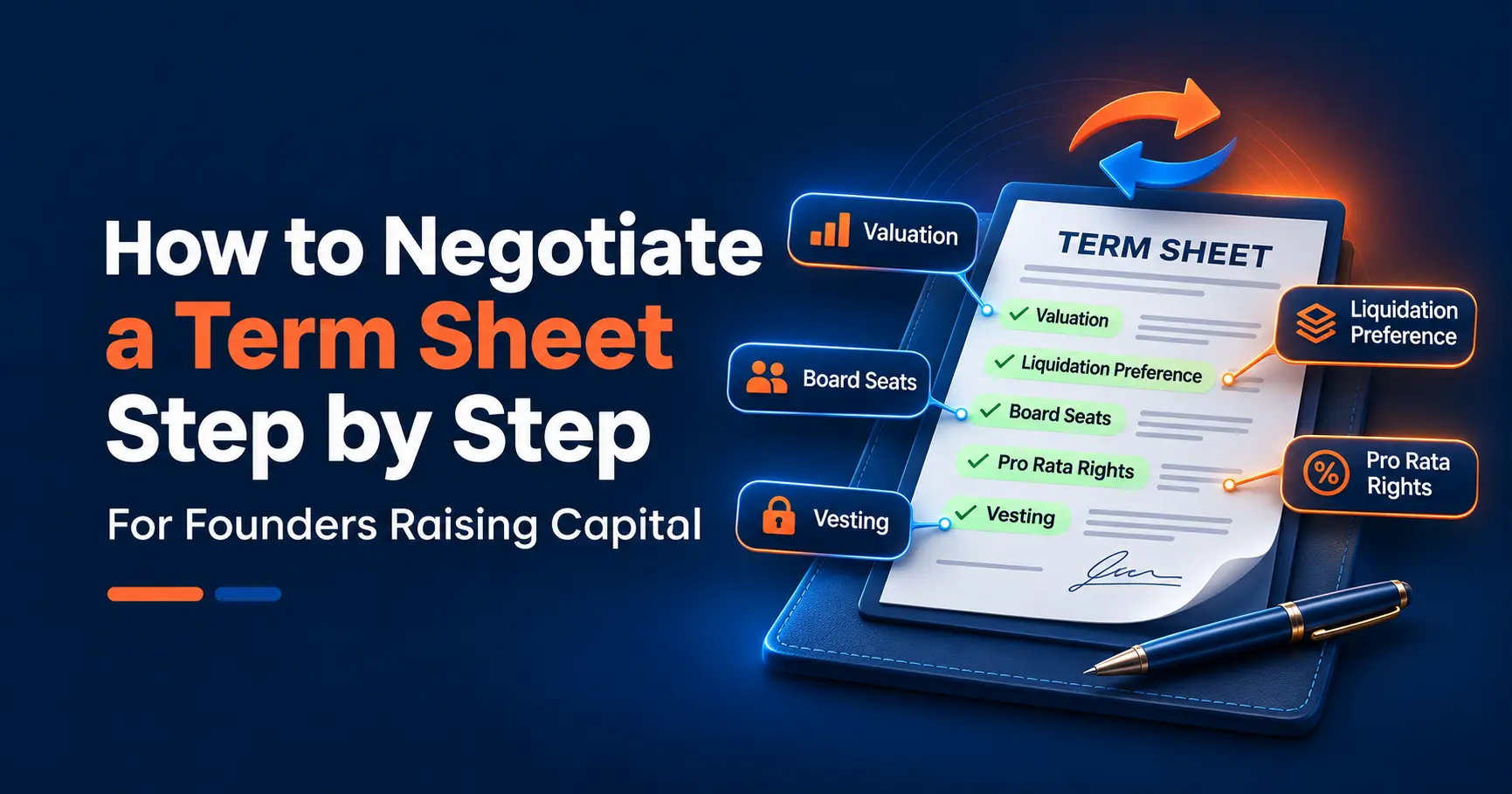
How to negotiate a term sheet as a founder:
- Build competing investor interest before you need it
- Line up your lawyer before the term sheet arrives
- Learn what market standard looks like for your stage
- Decide whether economics or control matters more to you
- Use your first term sheet to accelerate other conversations
- Negotiate the terms that move the outcome
- Know when to stop negotiating
- Close confirmatory diligence quickly
Here is the thing most founders miss: the term sheet is not where your leverage gets created. It is where your leverage gets spent. If you only have one investor at the table, there is not much to negotiate with, no matter how well you know the clauses.
The good news is that the market is on your side right now. According to Carta's State of Private Markets report for Q1 2026, down rounds have become rare again, dilution is falling, and liquidation preferences and participation rights are sitting near multi-year lows. In other words, investor-friendly terms are the exception in 2026, and founders who know that have more room to push back than they assume.
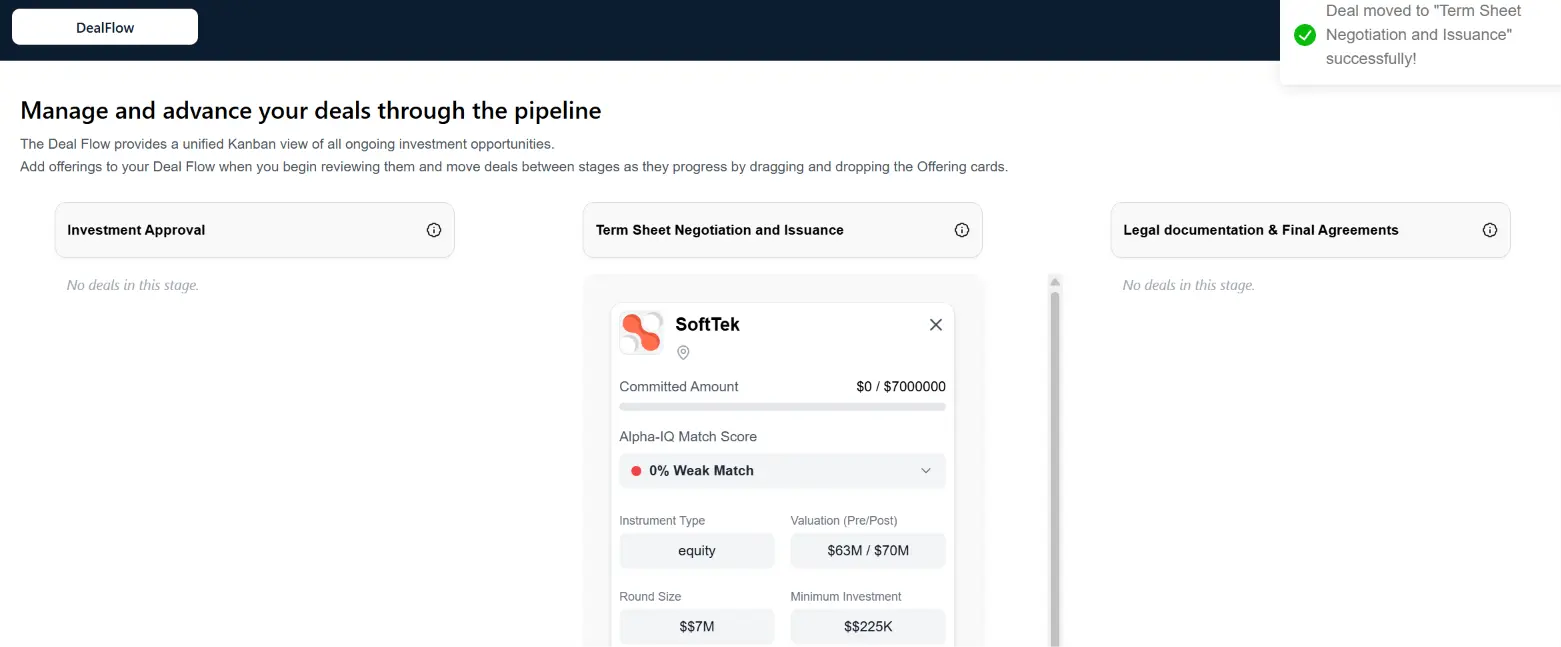
I see this stage up close at Alpha Hub. On our deal flow board, where investors track the startups they are evaluating on the platform, term sheet negotiation sits right after investment approval and right before legal documentation and final agreements. That placement tells you a lot. By the time you are negotiating a term sheet, the investor has already said yes internally. And once the lawyers start drafting final agreements, the terms are effectively locked. The term sheet is the point where an investment prospect becomes very real, and it is also the last window where you can shape the deal.
Here is how to make the most of that window, starting weeks before any term sheet shows up in your inbox.
1. Build Competing Investor Interest Before You Need It
The first step to negotiating a term sheet is building competing investor interest before you need it, because your negotiating position depends almost entirely on whether you have alternatives. An investor who knows you have other options will think twice before asking for a 2x liquidation preference or a board seat at seed. An investor who knows you have nothing else will not.
That means the real work starts weeks before any offer. You want several investors moving through their process at roughly the same pace, so that when the first term sheet lands, others are close behind. A pipeline where one investor is ready to commit and the rest are still at a first call gives you very little to work with.
A few things make this easier:
- Start outreach earlier than feels necessary. Investor processes slow down without warning, and you want slack in your timeline.
- Track where every investor stands, not just who you have talked to. Knowing which investors are in diligence and which have gone quiet tells you when you have leverage and when you don't.
- Compress your first meetings. If you run first calls with ten investors over two weeks instead of two months, their decisions are far more likely to land close together.
- Have your data room organized before outreach. Investors can't reach an approval decision without reviewing your financials, cap table, and key documents. If those take a week to pull together after every first call, the investors you are trying to keep in sync fall out of step.
This is where Alpha Hub fits in. Our investor discovery tool connects founders with relevant investors on the marketplace, and pipeline tracking lets you manage every conversation in one place. The Alpha Hub data room lets you create custom share links, share documents behind an NDA, and set access by document or folder. Once an investor starts evaluating your deal, you can also see which stage they have you in on the deal flow board, including the moment they move you to term sheet negotiation. Founders can't move those stages themselves, but the visibility tells you how close each investor is to an offer, which is exactly what you need to know when deciding how hard to push.
Needless to say, none of this works if you wait until you are almost out of runway. Leverage built under time pressure is not really leverage at all.
2. Line Up Your Lawyer Before the Term Sheet Arrives
You should line up your lawyer before the term sheet arrives because offers often come with short deadlines, and finding good counsel under pressure is how founders end up signing terms they don't fully understand. Some investors attach an expiration to their term sheet, sometimes as little as a day or two. That is not enough time to vet a law firm, get them up to speed on your company, and review the document properly.
Look for a lawyer who does venture financings regularly, not a generalist who handles a few deals a year. A lawyer who sees dozens of term sheets knows which terms are market and which ones are worth a fight, and that context is worth more than any clause-by-clause checklist.
Worth noting: term sheets commonly ask the company to cover the lead investor's legal fees at closing. Have your lawyer confirm that amount is capped, so a long confirmatory diligence process does not turn into a surprise bill.
3. Learn What Market Standard Looks Like for Your Stage
Learning what market standard looks like for your stage is what lets you tell the difference between a normal term and a red flag. You can't push back on an off-market term if you don't know it's off-market.
The data on this is clear. According to Cooley's Q2 2026 Venture Financing Report, 95.8% of deals had a 1x liquidation preference and 96.4% used nonparticipating preferred stock. In other words, if a term sheet offers you a 2x preference or participating preferred, you are looking at the exception, not the norm. The right response is to ask the investor what concern that term is meant to address, rather than accepting it as standard.
Anti-dilution protection is another term where a little knowledge goes a long way. Nearly every venture deal includes some form of it, but the type matters. According to Cooley, broad-based weighted average anti-dilution is the version you should expect, while full ratchet is the version that should send you straight to your lawyer.
Some investor-friendly terms are creeping back, though. Cooley's same report shows pay-to-play provisions in 8.4% of Q2 2026 deals, up from 7% the quarter before. Pay-to-play requires existing investors to participate in future rounds or lose some of their preferred rights. It is still uncommon, but it is the kind of term you want to recognize before you see it in your own documents.
4. Decide Whether Economics or Control Matters More to You
Deciding whether economics or control matters more to you gives you a clear set of priorities before the negotiation starts. Brad Feld, co-author of Venture Deals, argues that nearly every term in a term sheet falls into one of those two buckets, and that framing makes a long document much easier to prioritize.
Economic terms decide how much money you walk away with: valuation, option pool size, and liquidation preference. Control terms decide who makes the big decisions: board composition, protective provisions, and voting rights.
Most founders try to win on every term, and that is a mistake. You will not get everything, and fighting over every clause burns goodwill with an investor you will be working with for years. Instead, pick two or three must-haves before you open the term sheet. For example, a first-time founder at seed might decide that keeping a founder-majority board matters more than squeezing out a higher valuation. A founder with strong traction and multiple offers might do the opposite.
Write your must-haves down, along with the point where you would walk away. Having them on paper keeps you from trading away something important in the middle of a negotiation just to close a point that does not matter much.
5. Use Your First Term Sheet to Accelerate Other Conversations
You use your first term sheet to accelerate other conversations by telling the other investors in your pipeline that you have an offer and a timeline, then giving them a fair chance to catch up. This is the moment your leverage peaks, so how you handle it matters.
Email each investor individually rather than sending a group update. Tell them you have received a term sheet, that you are excited about their interest, and when you expect to make a decision. You don't need to share the terms or the name of the investor. The point is to give investors who were moving slowly a reason to move faster, not to start a bidding war.
Don't sign the first term sheet right away, even if you like it. According to Cooley, the only binding part of a term sheet is often a clause that stops you from talking with other investors for a set period after you sign. Once that no-shop clause kicks in, your alternatives disappear. Any negotiating you want to do has to happen before then.
This is another place where pipeline visibility pays off. On Alpha Hub's deal flow board, you can see which investors have already moved past investment approval and which are still earlier in their process. That tells you who can realistically produce a competing offer within your timeline and who can't, so you know how long a decision window is worth asking for.
6. Negotiate the Terms That Move the Outcome
The terms that move the outcome are valuation and the option pool, liquidation preference, board composition, protective provisions, and pro rata rights. Most other terms in a typical term sheet are standard and not worth spending negotiating capital on.
Valuation and the Option Pool
Valuation and the option pool should be negotiated together, because a larger option pool created before the investment lowers your effective valuation. Investors often ask for the pool to be sized in the pre-money, which means the dilution comes out of your shares rather than theirs.
The numbers add up quickly. According to Carta's 2026 Founder Ownership Report, the median founding team owns about 56% of the company after seed and about 36% after Series A. Carta's report also puts the median employee pool at seed at 12.1%. If a term sheet asks for a pool well above that, push back with a hiring plan that shows how many grants you will actually make before the next round.
Liquidation Preference
Liquidation preference decides who gets paid first, and how much, when the company is sold. As covered in Step 3, 1x non-participating is what the market expects. Anything above that is worth questioning, especially participating preferred without a cap.
Board Composition
Board composition decides who controls the company's biggest decisions, including hiring and firing the CEO. At seed, founders typically keep a majority of board seats. At Series A, a common structure is two founder seats, one investor seat, and one independent director. The independent seat often decides tie votes, so it is worth negotiating who picks that person.
Protective Provisions
Protective provisions give investors veto rights over specific company actions, even when the board approves them. According to Cooley, some of these are uncontroversial, like a veto on declaring dividends or changing the rights of the investors' stock. The ones to read carefully are vetoes over future financings or a sale of the company, since those can block decisions you will need to make later.
Pro Rata Rights
Pro rata rights let investors buy into future rounds to maintain their ownership. They are standard for your lead investor and usually fine. The thing to watch for is granting them to every small check in the round, or agreeing to super pro rata rights, which let an investor take more than their share of a future round and can crowd out new investors you want to bring in.
7. Know When to Stop Negotiating
You know when to stop negotiating when the term sheet is fair and comes from the investor you want. At that point, sign it and move on.
Jamie Goldstein, founding partner at Pillar VC, makes this point directly: if your preferred investor sends a fair term sheet, sign it. He warns that over-negotiating can lead an investor to conclude you are difficult to work with or that you are running an auction. Neither is a reputation you want with someone who is about to sit on your board.
Remember where this stage sits. On our deal flow board at Alpha Hub, term sheet negotiation is followed directly by legal documentation and final agreements. Anything you didn't fix in the term sheet will be very hard to reopen once the lawyers start drafting. So the goal is to settle your two or three must-haves from Step 4, let the rest go, and close.
8. Close Confirmatory Diligence Quickly
You close confirmatory diligence quickly by having every document the investor needs to verify already organized before you sign the term sheet. Confirmatory diligence is not where the investor decides whether to invest. That decision happened before investment approval. This stage is about confirming that what they already believe is accurate.
According to Holloway's guide to raising venture capital, once the term sheet is negotiated, the investor will ask for documents like your cap table, articles of incorporation, and contracts with outside vendors. Expect requests for IP assignment agreements, employee and contractor agreements, and board minutes as well.
Speed matters here more than most founders realize. The no-shop clause from Step 5 means you have already stopped talking to other investors. Every week confirmatory diligence drags on is a week where the investor's priorities could shift, the market could change, or a messy document could reopen terms you thought were settled.
The founders who move from term sheet to funding fastest are the ones whose documents are already in a data room, organized in folders that match what investors ask for. With the Alpha Hub data room, you can set access by investor or folder, keep everything behind an NDA, and see exactly which documents the investor has reviewed, so you know what is still outstanding before they have to ask.
What Term Sheet Terms Should Founders Never Accept?
The term sheet terms founders should never accept in a normal raise are uncapped participating preferred, full ratchet anti-dilution, investor control of the board at seed, and redemption rights the investor can trigger at will. Each one shifts outcomes heavily toward the investor, and none of them is market standard in 2026.
- Participating preferred without a cap. The investor gets their money back first and then takes their full ownership share of what's left. In a modest exit, this can wipe out a large part of what founders and employees receive.
- Full ratchet anti-dilution. If you ever raise at a lower price, the investor's shares get repriced as if they had invested at that lower price, regardless of how much was raised. Broad-based weighted average is the market version, and you should ask for it.
- Investor board control at seed. Giving up the board majority before you have found product-market fit means investors can outvote you on the decisions that define the company, including who runs it.
- Redemption rights at the investor's discretion. These let investors force the company to buy back their shares. According to Cooley's Q2 2026 Venture Financing Report, redemption provisions appeared in only 5.4% of deals, which tells you how far from standard they are.
There are exceptions. A company raising in a distressed situation, such as a down round or a rescue financing, may have to accept tougher terms as the price of staying alive. But if you are raising from a position of strength and see any of these in a term sheet, treat it as a negotiation starting point, not a final offer.
How to Negotiate a Term Sheet: Frequently Asked Questions
You can negotiate a term sheet, and most founders should, especially on the terms covered in Step 6. A term sheet is an opening offer, and investors expect founders to push back on terms that matter to them. The key is to negotiate on your two or three priorities rather than every clause.
It usually takes a few days to a week to negotiate a term sheet once an investor has decided they want to do the deal, according to SaaStr. If negotiations drag on much longer than that, it often signals a deeper disagreement about the deal itself rather than about individual terms.
Who names the valuation first matters less than most founders think, according to SaaStr. Many founders wait for the investor to make an offer, and that is fine. What matters more is knowing your own range in advance, based on comparable rounds at your stage, so you can respond with confidence either way.
A term sheet is mostly non-binding, meaning neither side is legally obligated to complete the investment on those terms. A few provisions are usually binding, though. According to Cooley, the most common is a no-shop clause that prevents you from talking with other investors for a set period after signing. Confidentiality provisions are often binding too.
An exploding term sheet is an offer with a short expiration deadline, after which the investor can withdraw it. Investors use deadlines to keep founders from shopping the offer to other investors. If you receive one, ask for a reasonable extension. A fair investor will usually grant a few extra days, and one who won't is telling you something about how they will behave after they invest.
You do need a lawyer to negotiate a term sheet, ideally one who handles venture financings regularly. A term sheet sets the foundation for the final legal agreements, and an experienced startup lawyer will spot off-market terms, explain how they play out in different exit scenarios, and keep you from agreeing to something that becomes expensive to undo later.