

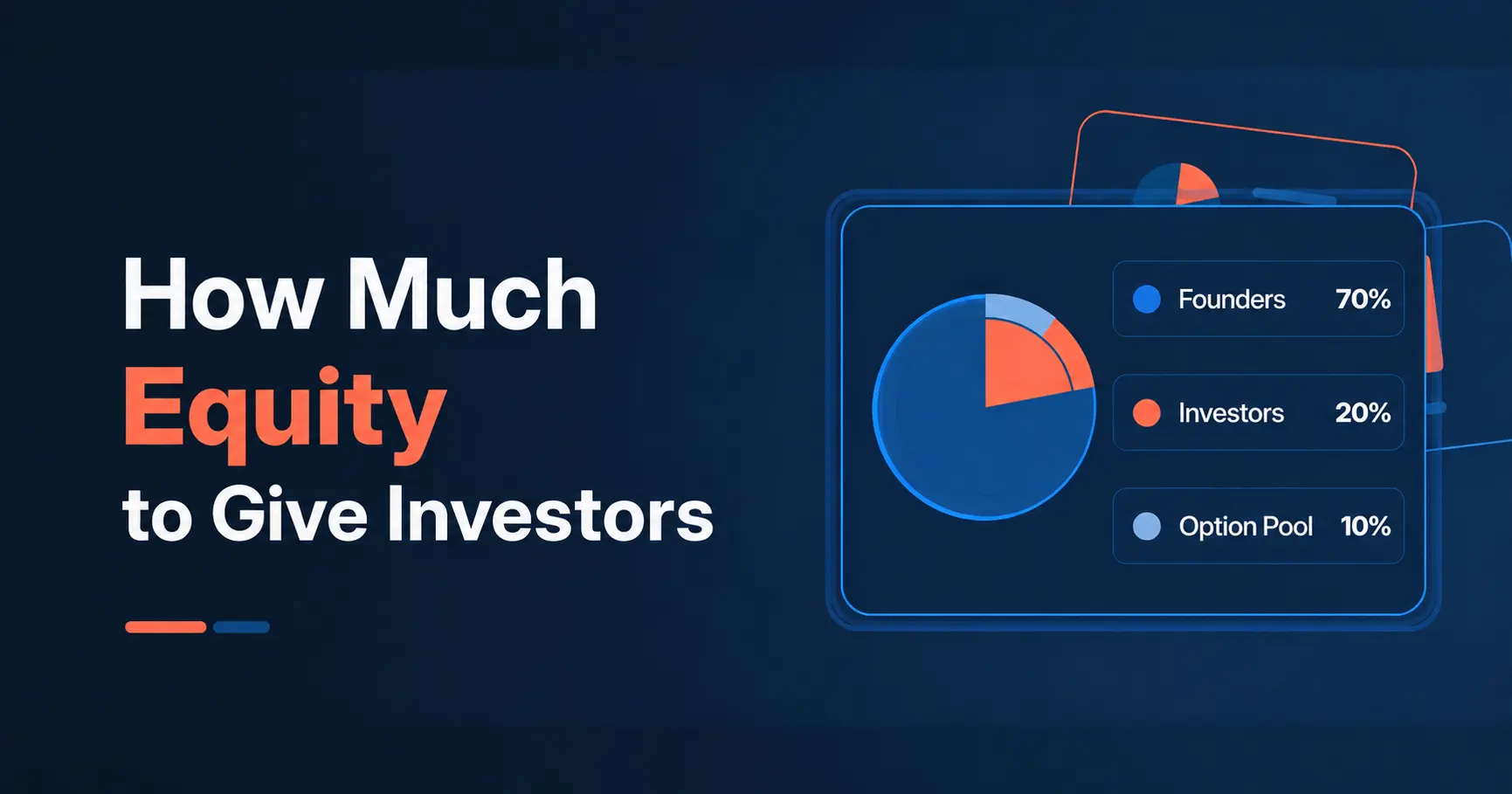
How much equity to give investors depends on your stage, but most founders give up 10% to 15% at pre-seed, about 20% at seed and Series A, and less in every round after that.
That question is landing on more desks than ever. First-time venture financings reached an estimated 5,674 deals in the first half of 2026, putting the year on pace for a record of more than 10,000 companies raising their first venture round, according to the PitchBook-NVCA Venture Monitor.
Most guides answer it with a single range pulled from one source. I wanted to see whether the numbers held up, so I put the latest 2026 data from Carta, Wilson Sonsini, and Equidam side by side. Here is the thing that stood out: valuations have climbed to record highs, but the slice of the company founders sell has barely moved. Higher valuations are buying founders bigger checks, not smaller stakes.
Below, you will find the stage-by-stage benchmarks, the math behind them, and how the right number shifts depending on your industry and the type of investor across the table.
How Much Equity Should You Give Investors at Each Stage?
You should give investors roughly 18% to 23% of your company at seed, 17% to 20% at Series A, and progressively less in every round after that. I landed on those ranges by comparing two independent datasets that measure dilution in different ways.
Carta reports actual median dilution. Across more than 1,000 software rounds raised in the six months leading up to July 2026, the median seed round sold 18% of the company, Series A sold 18%, Series B sold 12%, Series C sold less than 10%, and Series D sold 8%, according to Carta.
Wilson Sonsini, one of the most active venture law firms in the U.S., publishes the median round size and median pre-money valuation from its own deals every quarter. It does not report dilution directly, so I calculated it. Implied dilution equals the median amount raised divided by the median post-money valuation (pre-money valuation plus the amount raised). For example, the median seed round in Q2 2026 raised $6.7 million on a $23.0 million pre-money valuation, according to Wilson Sonsini. That works out to 22.6%.
Here is how the two sources compare:
| Stage | Carta median dilution (H1 2026) | Wilson Sonsini implied dilution (Q2 2026) | Wilson Sonsini implied dilution (full-year 2025) | Range to plan around |
|---|---|---|---|---|
| Seed | 18% | 22.6% | 19.3% | 18% to 23% |
| Series A | 18% | 17.1% | 19.9% | 17% to 20% |
| Series B | 12% | 10.8% | 13.9% | 11% to 14% |
| Series C and later | Under 10% (Series C), 8% (Series D) | 3.7% | 9.2% | 8% to 10% |
The two sources line up closely through Series B. The outlier is Wilson Sonsini's Q2 2026 figure for Series C and later, where a median pre-money valuation of roughly $2.6 billion pushed implied dilution below 4%. Wilson Sonsini itself cautions that its latest-stage figures likely reflect a small number of outsized deals rather than a broad repricing, so I weighted its full-year 2025 number more heavily for that row.
What the table really shows is how stable the percentage stays while the dollars move. Wilson Sonsini's median seed pre-money valuation climbed from $17.0 million in 2024 to $23.0 million in Q2 2026, yet implied seed dilution stayed between 18% and 23% the entire time, according to Wilson Sonsini. Carta found the same pattern: seed and Series A dilution medians held between 19% and 20% through the end of 2025 even as valuations set records, then slipped to 18% in 2026. In other words, investors are paying more for roughly the same slice. That is why the amount you raise matters as much as the valuation you negotiate.
A note on the numbers: implied dilution is a ratio of two medians, not the median of actual deals, so treat it as a benchmark rather than a precise figure. It also leaves out option pool increases, which push your real dilution higher in a priced round (more on that below). Finally, each dataset has its own lens. A law firm's deal book skews toward larger, institutionally led rounds, and Carta's figures cover software companies only.
How Do You Calculate How Much Equity to Give an Investor?
You calculate how much equity to give an investor by dividing the investment amount by the post-money valuation. The post-money valuation is your pre-money valuation plus the new money coming in.
Here is a quick example. Say you raise $2 million at an $8 million pre-money valuation. Your post-money valuation is $10 million, so the investor owns 20% ($2 million divided by $10 million). Raise the same $2 million at a $12 million pre-money valuation and the investor owns 14.3% instead.
That is why experienced founders negotiate the round size and the valuation, not the percentage. The percentage is just the output. You have two levers to move it: raise less money, or raise at a higher valuation. Nearly every tactic in this guide comes back to one of those two.
Worth noting: investors sometimes quote a valuation without saying whether it is pre-money or post-money. On a $2 million raise, "$10 million" means you sell 20% if it is post-money and 16.7% if it is pre-money. Always ask which one they mean before you compare offers.
How Does the Option Pool Affect Your Dilution?
The option pool affects your dilution because investors usually require it to be created or expanded before their money comes in, so the cost comes out of the founders' share alone. This is often called the option pool shuffle.
For example, take the same $2 million raise at an $8 million pre-money valuation. If the term sheet also requires a 10% option pool included in the pre-money valuation, the investor still owns 20%, the pool takes 10%, and you and your co-founders end up with 70% instead of 80%. Your effective pre-money valuation just dropped from $8 million to $7 million.
Pools of this size are normal. The median employee pool at the seed stage is 12.1% of the company, according to Carta's Founder Ownership Report 2026.
You cannot usually avoid the pool, but you can size it. Build a hiring plan for the next 12 to 18 months, estimate the grants each hire will need, and propose a pool that covers that plan rather than a round number. A pool that is bigger than your hiring plan is dilution you pay for today and may never use.
How Do You Decide How Much Money to Raise?
You decide how much money to raise by working backward from the milestone your next round depends on, then adding a buffer for delays. That number matters as much as your valuation, because the equity you give up is the amount you raise divided by your post-money valuation. Every dollar you raise without a plan for it is equity you sold without a reason.
Start with the milestone. Name the specific result that will justify a higher valuation next time, such as a product launch, a revenue target, a regulatory approval, or a set number of paying customers. Then estimate how long it will take to get there, and give yourself a few months of cushion, because almost everything takes longer than planned.
Next, turn that timeline into a use of funds breakdown. This shows what the money pays for, by category, until you reach the milestone: new hires, product development, sales and marketing, operations, and a reserve. If you have not built one before, this use of funds example walks through how to structure it.
Here is how it changes your equity. Say you need 18 months to reach your next milestone, and your plan looks like this:
- Four key hires: $900,000
- Product development: $300,000
- Sales and marketing: $250,000
- Operations: $150,000
- Reserve: $200,000
That totals $1.8 million. At a $10 million pre-money valuation, raising $1.8 million sells 15.3% of your company. Round it up to $2.5 million "just in case" and you sell 20%. That extra $700,000 costs you almost five more points of ownership, and those points compound through every round that follows.
A clear use of funds also makes you a stronger negotiator. When an investor pushes for a bigger round or a larger stake, you can point to exactly what the money is for and why you do not need more. Investors read that as discipline, and it keeps the conversation focused on your valuation instead of your percentage.
How Much Equity Should a Pre-Seed Company Give Away?
A pre-seed company should aim to give away 10% to 15% and treat 20% as a ceiling. The reason is simple: pre-seed equity is the cheapest equity you will ever sell, and the seed round right behind it will take close to another 20%.
Run the math forward and you can see why the ceiling matters. If you sell 20% at pre-seed, then 20% at seed, then add a 10% option pool, you and your co-founders own roughly 58% of the company before you have even raised a Series A. That lines up almost exactly with Carta's finding that the median founding team retains about 56% of fully diluted equity after its seed round, according to the Founder Ownership Report 2026. Hold your pre-seed to 15% and the same path leaves you with about 61%.
How much you give up at pre-seed tracks how much you raise. Across pre-seed companies valued on its platform, Equidam found average implied dilution of roughly 13% in the second half of 2025. Software & IT companies sat at 13.2% on a median capital requirement of $0.85 million. U.S. founders, however, averaged 27.7%, largely because their median capital requirement was $1.75 million, according to Equidam. In other words, a bigger pre-seed round does not just cost more in dollars. It costs more in ownership.
The market is also getting tighter at this stage. U.S. startups on Carta raised $3.19 billion across roughly 11,500 pre-seed instruments in Q2 2026, compared with $3.22 billion across 14,825 instruments a year earlier, according to Carta. The same money is going into fewer companies, and the average check hit a record $276,000. Valuation caps are also softening in some datasets. The median SAFE valuation cap in Wilson Sonsini's deals fell to $15.0 million in the first half of 2026, down from $20.0 million in 2025, according to Wilson Sonsini. Needless to say, the cap a friend raised on last year is not a safe number to plan around.
How Do SAFEs Affect How Much Equity You Give Away?
SAFEs affect how much equity you give away by delaying the math, not by avoiding it. A post-money SAFE fixes the investor's ownership at the moment you sign: $500,000 on a $10 million post-money cap converts to 5% of the company when your priced round closes. Post-money structures are now the norm, used in 89% of capped SAFEs in the first half of 2026, according to Wilson Sonsini.
The trap is stacking. Because each SAFE is its own small agreement, it is easy to lose track of the total. Here is how quickly it adds up:
- $500,000 on an $8 million post-money cap = 6.25%
- $750,000 on a $10 million post-money cap = 7.5%
- $1 million on a $12 million post-money cap = 8.3%
That is 22.1% of the company gone before your seed investors buy a single share, and before any option pool top-up. For context, Carta's median post-money SAFE caps in 2025 were around $10 million for rounds between $250,000 and $1 million and around $15 million for rounds between $1 million and $2.5 million, according to Carta. None of the caps in the example above is unusual.
The fix is easy: update your cap table model every time you sign a SAFE, and look at the fully converted number, not the individual checks.
What Is a Broken Cap Table?
A broken cap table is one where founders own too little of the company, or too much equity sits with people who no longer contribute, for new investors to feel comfortable backing it. Founder ownership dropping below 50% at the seed stage can signal the start of dilution problems, ownership under 40% by Series A is considered risky, and ownership below 20% by Series B or later is a clear red flag, according to Entrepreneur.
Investors care because your stake is your incentive. If founders already own a minority before the company has product-market fit, the next investor has to wonder whether you will stick around through the hard years, and whether there is enough equity left to attract the team you still need to hire.
If you need more capital than a 10% to 15% pre-seed can cover, consider a staged raise instead of one large round. Raise a smaller first check to prove one specific milestone, then raise the rest once that milestone justifies a higher valuation. You sell the same total amount of money, but a meaningful share of it at a better price.
Does Your Industry Change How Much Equity You Give Up?
Your industry changes how much equity you give up because it sets both how much capital you need and how many investors are competing to fund you. Capital-hungry businesses raise bigger rounds, and sectors with heavy investor demand command higher valuations. Those two forces pull your dilution in opposite directions.
The gap shows up clearly by the time founders reach Series A. Founders of the median startup in a digital industry retain 37.5% of their equity after a Series A, while founders in physical industries retain 30.5%, according to Carta's Founder Ownership Report 2026. That is a seven-point difference before anyone has raised a Series B.
AI Companies
AI companies give up less equity for the same money because investor demand is pushing their valuations far above everyone else's. AI accounted for 86% of all U.S. venture dollars in the first half of 2026, according to the PitchBook-NVCA Venture Monitor. The gap is widest at the top: a foundational model startup at Series A might raise at a $300 million median valuation, compared with $55 million for a non-AI startup at the same stage, according to Carta.
That premium carries through to ownership. At Series B, the median AI founding team holds 27.3% of its fully diluted equity, compared with 21.8% for non-AI founding teams, according to Carta.
Here is the thing, though: the premium goes to companies where AI is the product, not a feature. Adding "AI" to a deck without a real technical edge will not move your valuation, and investors in this market have seen thousands of those decks.
SaaS and Non-AI Software
SaaS and non-AI software companies usually give up less equity early because they need less capital to reach their first milestones. At pre-seed, Software & IT companies showed the lowest implied dilution of any industry Equidam tracked, at 13.2% on a median capital requirement of $0.85 million.
The challenge comes later. Carta describes SaaS as facing a real question about its future, noting that it is the category most likely to be disrupted by capable AI and also the largest category in its data. For a non-AI software founder, that means the investor pool at Series A is thinner and more skeptical. Your best protection is capital efficiency: the less you need to raise before you have strong revenue, the less you will have to sell at valuations that reflect that skepticism.
Hardware, Biotech, and Deep Tech
Hardware, biotech, and deep tech companies typically give up more equity because building physical products or running clinical work requires far more capital before revenue arrives. That is the main driver behind the 30.5% versus 37.5% Series A ownership gap Carta found between physical and digital industries.
The good news is that capital-intensive founders are commanding higher valuations to match. Equidam found that founders raising for more capital-intensive businesses are pricing their rounds higher, which keeps dilution in check at pre-seed. Two tools make the biggest difference from there:
- Tranched rounds. Investors release capital in stages as you hit milestones, so you are not selling all your equity at your earliest, lowest valuation. The share of life sciences venture financings structured in tranches rose to 29.6% in Q2 2026, up from 28.1% the prior quarter, according to Cooley.
- Non-dilutive capital. Grants and debt can fund a technical milestone without selling any equity. Carta reports that non-dilutive debt is letting hardware founders build before they raise and arrive at institutional rounds with less dilution than prior generations. For U.S. founders, the reauthorization of the SBIR and STTR programs restores early-stage non-dilutive R&D funding through 2031, according to NVCA.
Every dollar of grant or debt funding that gets you to a milestone is a dollar you do not have to raise at your lowest valuation.
Small Businesses and Non-Venture Companies
Small businesses and non-venture companies should not use venture benchmarks at all, because their investors get paid in a completely different way. A venture investor makes money when the company sells or goes public. A restaurant, agency, or local service business may never do either, so an ownership percentage on its own does little for the investor unless it comes with a way to get cash back.
That changes the question from "what percentage?" to "how does the investor get paid?" A few common structures:
- Equity with profit distributions. The investor owns a stake and receives that share of profits. For example, an investor who puts in $100,000 for a 10% stake would receive 10% of the profits the business distributes, according to the U.S. Chamber of Commerce.
- Revenue-based financing. The investor is repaid from a percentage of monthly revenue until they reach an agreed multiple of their investment, and you give up no ownership.
- Equity with a buyback clause. The investor takes a stake, but you have the right to buy it back later at a preset price or multiple, so the dilution is not permanent.
Small businesses also have the most to lose from casual equity deals. A relative who invests $25,000 for 2% becomes a permanent shareholder, and small stakes handed out to early helpers can complicate every decision and future raise that follows, according to Angel Investors Network. If you run a business that is not built for a venture-style exit, work with a lawyer or accountant to structure the deal before you agree to a percentage.
Does the Type of Investor Change How Much Equity to Give?
The type of investor changes how much equity to give because each one has a different ownership target and a different idea of what a good outcome looks like. A venture fund needs a big enough stake to return its fund. A family office may be happy to hold a smaller position for a decade. A friend or relative may not have a target at all, which creates its own problems.
The total you sell in a round is still what drives your dilution. But knowing what each investor type expects tells you where you have room to negotiate and which terms matter more than the percentage.
Angel Investors
Angel investors usually take small individual stakes because they write small checks. At pre-seed, individual angels typically invest $10,000 to $50,000, and at seed that rises to $25,000 to $100,000, according to Angel School. Most founders combine several angels into one round, so no single angel ends up with a large percentage.
The bigger risk with angels is not the size of any one stake. It is the number of names on your cap table. If you are raising from many angels, consider an angel syndicate, which pools their capital into a single investment vehicle. Syndicates can bring in $250,000 to $1 million or more while keeping your cap table clean, often by consolidating investors into one SPV, according to Angel School.
Venture Capital Firms
Venture capital firms target a specific ownership percentage, and that target often matters more to them than the valuation. Most larger VC firms, with funds between $250 million and $2 billion, want to own about 20% of each company they back and will often pay a higher price to get it, according to SaaStr. Add your existing investors taking their pro rata share and a Series A often ends up selling closer to 25% in total.
Early-stage funds are even more focused on this. In an interview published in the Q2 2026 PitchBook-NVCA Venture Monitor, a managing partner at BBG Ventures said that if she were starting a fund today, up-front ownership is the discipline she would hold onto, because early ownership matters so much for a smaller firm.
For you, this has a practical implication. If a VC's ownership target is fixed, your room to negotiate is on round size and valuation together. A fund that needs 20% would usually rather write a bigger check at a higher valuation than accept a smaller stake.
Family Offices
Family offices tend to accept smaller stakes and lighter governance than venture funds, because they are investing their own capital with no fund deadline forcing an exit. That makes them a strong fit for founders who want patient capital without giving up board control.
They are also more active than ever. In Citi's 2025 Global Family Office Report, 70% of family offices surveyed said they were engaged with direct investments, and 40% of those had increased or significantly increased that activity in the past year. Citi's 2026 Global Family Office Report, based on a survey of 351 family offices in 41 countries, found that direct investing is continuing to increase and that growth-stage opportunities are drawing strong interest. It also found family offices becoming more selective, with greater emphasis on sourcing, expertise, and differentiated access, according to Citi.
On governance, most family offices do not want or need a board seat and will settle for observer rights or quarterly updates, according to Value Add VC. Treat the opposite as a warning sign. A family office asking for a board seat on a small check, such as $500,000 in a $3 million round, is signaling a desire for control out of proportion to its stake, according to StartupFundraising.com.
Friends and Family
Friends and family should get the same terms as every other investor in the round, not a special percentage negotiated over dinner. The mistake founders make here is handing out small, loosely documented stakes to people they trust. Those 1%, 5%, and 10% pieces given to relatives, advisors, and early helpers tend to become headaches later, because every shareholder is permanent and you will want that equity for future employees, according to LivePlan.
The easiest fix is to have friends and family invest on the same SAFE as your other early investors, at the same cap. It keeps the paperwork clean, puts everyone on equal footing, and avoids a conversation years from now about why your uncle owns more of the company than your first engineer.
Corporate and Strategic Investors
Corporate and strategic investors should usually get a small minority stake, because the rights they ask for can matter more than the percentage. Corporate venture investors participated in just 21.1% of U.S. venture deals in the first half of 2026, the lowest share in the past decade, according to the PitchBook-NVCA Venture Monitor. Many corporates are holding cash on their balance sheets to cover rising AI costs rather than writing new venture checks.
When a corporate investor does come in, the value is usually distribution, customers, or technical support. The risk is terms that limit your options later, such as a right of first refusal on an acquisition or access to information that a competitor would love to see. Keep a strategic investor's stake modest and read the side terms as carefully as the valuation.
How Much Ownership Should Founders Keep After Each Round?
Founders should keep a majority of the company after the seed round and ideally a third or more after Series A. Those targets match what the typical venture-backed founding team actually retains. The median founding team holds about 56% of its fully diluted equity after raising a seed round, and about 36% after raising a Series A, according to Carta's Founder Ownership Report 2026, which is based on rounds raised from 2021 through 2025.
After that, the numbers keep sliding. By Series C, the median employee equity pool (16.8%) is larger than the median founding team's stake (16.1%), according to Carta.
Here is what surprises most founders: the headline round percentages alone do not explain that drop. If you sold 15% at pre-seed, 20% at seed with a 10% option pool, 18% at Series A, 12% at Series B, and 10% at Series C, your founding team would still own roughly 40% after Series C. The median team owns 16.1%. Most of that gap comes from dilution that never shows up in the round headline: option pool refreshes, bridge rounds, extensions, and extra SAFEs signed between rounds.
That is why the most useful exercise is to work backward. Decide what you want to own when you raise your Series A, then model every raise between now and then, including the option pool top-ups. If the model says you will be under a third by Series A, change the plan now, while you still control the inputs. Raise less, stage your raise, or wait for a milestone that justifies a higher valuation.
How Can You Give Up Less Equity for the Same Money?
You can give up less equity for the same money by raising only what your next milestone requires and by running a process with enough investors to create competition. Everything else is a refinement of those two moves.
-
Raise to a milestone, not a number. Work out the specific result that will justify a higher valuation in your next round, then raise enough to reach it with some buffer. Carta's own insights team makes the point that valuations are often just the output of cash raised and dilution, and that the biggest valuations usually come with the biggest checks. The better question is how much cash you really need.
-
Create competition. The same pre-seed dollars are now chasing fewer companies, according to Carta, which means investors are concentrating on the rounds they want most. A single interested investor sets the terms. Several interested investors let you set them. Build a longer investor list than you think you need and run your meetings close together so offers arrive in the same window.
-
Size the option pool to your hiring plan. As covered above, a pool created before the investor's money comes in is paid for entirely by the founders. Every point you trim from an oversized pool is a point you keep.
-
Use non-dilutive capital where it fits. Grants, revenue, and debt can all fund progress without selling equity. Be realistic about debt, though. Venture loan counts fell to 280 in the first half of 2026, and availability for the typical company remains constrained and concentrated in AI, according to the PitchBook-NVCA Venture Monitor.
-
Do not accept aggressive terms in a founder-friendly market. Terms today favor companies. In Q2 2026, 95.8% of deals carried a standard 1x liquidation preference and 96.4% used non-participating preferred stock, according to Cooley. Senior liquidation preferences appeared in just 16% of Series B and later financings in the first half of 2026, down from their 2022 highs, according to Wilson Sonsini. If a term sheet includes participating preferred, a multiple liquidation preference, or other unusual protections, push back. The market does not require them.
One more point: the highest valuation is not always the best offer. Founders with competing term sheets often accept a lower valuation to work with a more reputable investor, according to CRV. A slightly lower price from an investor who will help you hire, sell, and raise your next round can be worth more than a few points of ownership.
Frequently Asked Questions
How much equity you should give for a $100,000 investment depends on your valuation. At a $5 million post-money valuation, $100,000 buys 2% of the company. At a $10 million post-money valuation, it buys 1%. Agree on the valuation first, and the percentage follows. For a small business without a venture-style exit, focus instead on how the investor gets paid back, such as profit distributions or a buyback clause.
1% equity in a startup is a normal stake for a single angel check. For example, a $100,000 investment at a $10 million post-money valuation buys exactly 1%. For the founder, giving 1% to one investor is not a concern. The concern is how many 1% stakes you hand out, and to whom, because every shareholder stays on your cap table permanently.
7% equity is a moderate stake for one investor in a round, but it is a lot for anyone who is not investing capital or working in the business full time. Across a whole seed or Series A round, 7% would be well below the roughly 17% to 23% investors typically buy, so it usually means either a small round or a strong valuation.
Giving investors 80% equity is too much for almost any startup, because it leaves the founders with 20% before later rounds, option pools, and future hires dilute them further. At that point, most new investors will see a broken cap table. The main exception is a control transaction, such as a private equity buyout, where selling a majority of the business is the point of the deal.
A SAFE gives away equity, just not right away. It converts into shares at your next priced round, at a price set by its valuation cap or discount. With a post-money SAFE, the investor's ownership at conversion is fixed when you sign, so $500,000 on a $10 million post-money cap becomes 5% of the company. Track every SAFE in your cap table model so the total does not surprise you at your seed round.
If you give away too much equity early, future investors may pass on your company because the founders no longer own enough to stay motivated through the hard years. You will also have less room to create an option pool for the team you still need to hire. It can sometimes be repaired through a recapitalization or new founder equity grants, but those fixes are expensive and require investor approval. Preventing the problem is far easier than fixing it.