

To find investors for a startup:
- Set up a virtual data room
- Leverage your warm network first
- Get visibility through Alpha Hub's marketplace
- Tap into angel investor networks and syndicates
- Run targeted cold outreach
- Attend investor events, pitch competitions, and accelerators
- Build visibility on LinkedIn and X
- Consider equity crowdfunding as a broader net
Raising capital has gotten slower and more competitive even as the money available hasn't dried up. The median time from seed to Series A now sits at 774 days according to Carta's Q4 2024 data, about 84% longer than it took in 2021. Founders typically need to reach more than 200 investors just to close a single seed round, according to NYU's 2025 Entrepreneurship research. Meanwhile, private capital funds are sitting on $4.63 trillion in dry powder still waiting to be deployed, according to PitchBook's Q2 2025 report. The capital is there. Getting in front of the right slice of it, efficiently, is what's actually hard.
I've seen this firsthand raising Alpha Hub's own seed round and talking with the founders raising capital on our platform every day.
Step 1: Set Up a Virtual Data Room
Before you reach out to a single investor, get your data room in order. This is the step most founders treat as an afterthought, something to throw together the night before a meeting, and it shows. A data room that's disorganized or incomplete signals to an investor that you're not ready, even if the business itself is.
Start by setting up a free data room on Alpha Hub, built specifically for founders raising capital rather than repurposed from a general file-sharing tool. Upload your cap table, financials, pitch deck, and any legal documents an investor will expect to see, then organize them into folders an investor can actually navigate without asking you where something is. Set granular permissions so you control exactly what each investor sees, and use NDA gating for anything sensitive you want protected before you share it more broadly.

Preparing these documents well is a real team effort, not something one founder knocks out solo. At Alpha Hub, our finance team, business development and capital raising team, and marketing team all had a hand in getting our own materials investor-ready, the finance team on the numbers, BD on framing the raise itself, and marketing on making sure the research and branding behind it actually held up under scrutiny. If you're a solo founder, that might mean leaning on an advisor or a co-founder for a second set of eyes rather than doing this entirely alone.
Once your data room is live, everything else in this guide gets easier, since you're never caught flat-footed when someone finally says yes to a meeting.
Step 2: Leverage Your Warm Network First
Before you send a single cold email, work through the people who already know and trust you. This means two things: reaching out directly to people in your circle who might invest or know someone who will, and asking the people you trust most to make a direct introduction to an investor they already have a relationship with. Both routes beat a cold message to a stranger, since you're starting from existing trust instead of building it from zero.
Start close. Former colleagues, past managers, advisors, mentors, anyone who has seen you work and would speak well of you, whether they invest themselves or simply know people who do. Then widen out to your existing investors if you have any, since they typically have the deepest networks and the most incentive to help you close your round successfully. Don't overlook people who aren't investors themselves but know investors, a lawyer who works with startups, an accountant with VC clients, a founder who raised before you.
This isn't a hypothetical for us. During Alpha Hub's own seed round, our CEO secured a significant commitment from a European family office through a direct introduction from a previous investor, rather than starting from a cold list. That single warm connection did more for our raise than a much larger volume of cold outreach would have.
Before you reach out, get specific about the ask. A vague "let me know if you hear of anyone" rarely produces results. Instead, tell the people in your network exactly who you're looking for, the stage, the check size, the sector focus, so they can actually think of a name rather than filing your request away and forgetting about it.
Step 3: Get Visibility Through Alpha Hub's Marketplace
Once your data room is live, you're not just prepared for outreach, you're also visible inside Alpha Hub's marketplace, where investors are actively browsing for founders raising capital right now. This works differently from a cold pitch: instead of you chasing an investor's attention, you're positioned in front of investors who are already looking.
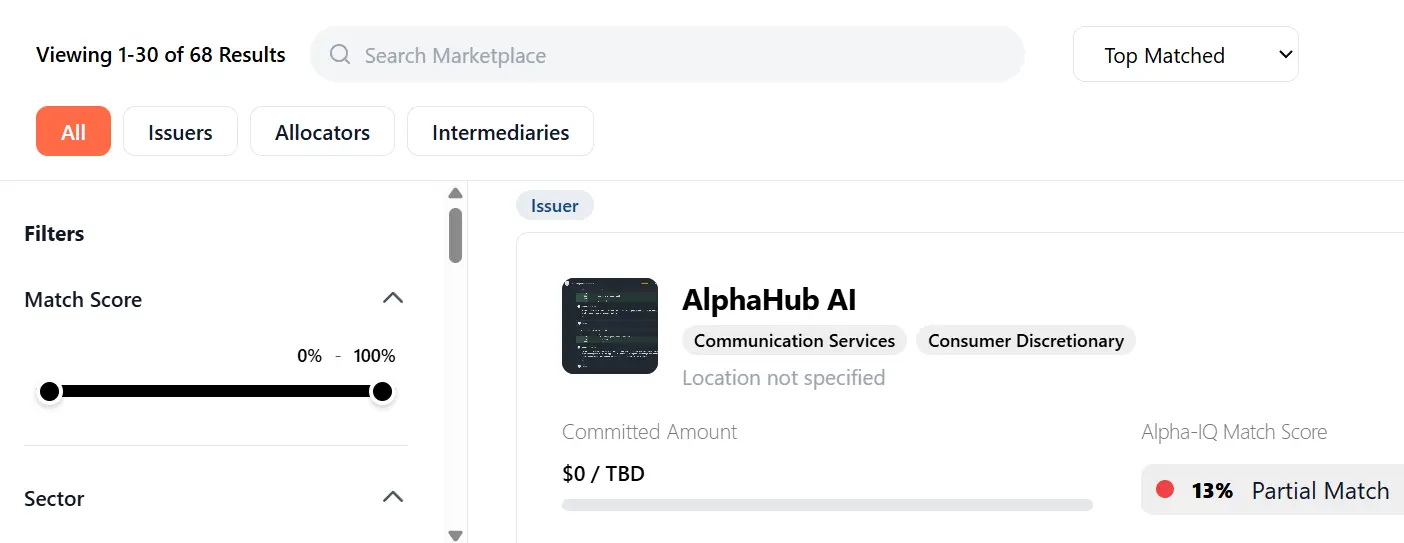
Each investor profile you can browse includes an Alpha IQ score, a signal built to show how well your startup aligns with that investor's focus, stage, and check size, so you're not guessing which investors are worth your time. Rather than working through a generic list and hoping for a fit, you can see likely alignment before you ever reach out.
This step works best in combination with step 2, not instead of it. A warm introduction still carries the most weight, but marketplace visibility means you're not solely dependent on who happens to be in your network already.
Step 4: Tap Into Angel Investor Networks and Syndicates
Individual angel investors can be hard to find on your own, but many operate inside organized networks and syndicates that pool together deal flow, making them far easier to reach than cold-emailing angels one at a time. Joining one of these groups gets you in front of multiple aligned investors at once instead of building a list from scratch.
Platforms like AngelList let you browse organized syndicates and submit your startup for consideration, while regional and industry-specific angel groups often run their own application processes and regular pitch sessions. Search for angel networks focused on your specific sector or geography first, since a fintech-focused syndicate is going to be a better use of your time than a generalist group with no thesis around what you're building.
Angels in a syndicate also tend to move faster and write smaller checks than a typical VC firm would, which makes them a good fit earlier in a raise, particularly for founders who haven't built up a large personal network yet. Getting into one syndicate can also open doors to others, since angel investors frequently co-invest and share deal flow with each other.
Step 5: Run Targeted Cold Outreach
Cold outreach has a lower response rate than warm intros or a curated marketplace, but it's still worth doing, especially once you've worked through your network and you're ready to expand your pipeline beyond people you already have some connection to. The key word is targeted. A mass email blast to a generic investor list wastes your time and theirs.
Research each investor before you reach out. Look at their portfolio, their stated thesis, and any recent public commentary on what they're looking for, then reference something specific in your outreach that shows you actually did the homework. A message that clearly could have been sent to a hundred other investors gets treated like it was.
Cold email isn't a high-percentage game in any context. Across B2B outreach generally, the average response rate sits around 3.43%, according to Instantly's benchmark analysis of billions of email sends. Investor outreach tends to perform even lower without a specific, researched angle, which is exactly why targeting matters more than volume here.
Cold email is one of the outreach methods we've used ourselves in Alpha Hub's own campaigns, and it works best as a volume channel layered on top of the higher-converting steps above it, not as your primary strategy. Tools like OpenVC let you browse a large investor database and self-serve your outreach from there, which can be useful for building your initial list, though it's worth remembering that finding the investor is still on you. That's different from Alpha Hub's marketplace, where investors are already browsing and you're not starting from zero.
Keep a simple tracker of who you've contacted, when, and what you said, so you're not accidentally reaching out twice or losing track of who still owes you a reply.
Step 6: Attend Investor Events, Pitch Competitions, and Accelerators
Showing up in person, or at least live and interactive rather than through a written message, still moves the needle in fundraising. Investor meetups, industry conferences, and demo days put you in front of multiple investors in a single sitting, and the in-person or live format tends to build more trust faster than a written pitch ever could.
Accelerator programs deserve particular attention here, since they offer more than a check. A program like Techstars or Y Combinator gives you structured mentorship, a cohort of other founders going through the same process, and direct access to a network of investors who already trust the accelerator's vetting. Getting in is competitive, and the equity you give up needs to be weighed against what the program actually provides, but for a first-time founder without an established network, that credibility boost can be worth more than the capital itself.
Pitch competitions work a bit differently. They're lower stakes than an accelerator application and can be a good way to get reps in on your pitch while getting in front of investors who are specifically there to scout. Even competitions you don't win can lead to a follow-up conversation with a judge or attendee who liked what they saw.
This step tends to convert more slowly than warm intros or a targeted email, since you're often meeting someone for the first time with no existing context. Think of it as compounding rather than immediate. The relationships you build at an event today can become the warm network you're drawing on for your next round, so it's worth treating consistently rather than as a one-off effort right before you need capital.
Look for events and programs specific to your industry and stage rather than generic startup meetups, since a room full of investors who already care about your sector is a far better use of an evening than a general networking event with no thesis behind it.
Step 7: Build Visibility on LinkedIn and X
Not every investor conversation starts with you reaching out. Founders who are active and visible online, sharing progress, insights, and updates on what they're building, end up in inbound conversations they never had to chase. This is the slowest channel on this list to pay off, but it's also the one that keeps compounding in the background while you're working the others.
Post about real milestones and lessons rather than generic motivational content. Investors scrolling LinkedIn are looking for signal, traction, a sharp insight about your market, evidence you understand your space, not a highlight reel. Engaging thoughtfully with investors' own posts and industry conversations can also put you on their radar before you've ever sent them anything directly.
Direct messages can work here too, but the same rule applies as with cold email: a personalized message referencing something specific about the investor's focus or recent activity performs meaningfully better than a generic pitch dropped into someone's inbox. Skip the long message that reads like a pitch deck in text form. A short, specific note asking for a conversation lands better than an unsolicited wall of text.
X is worth building a presence on too, particularly since a meaningful amount of real investor activity happens there. Funds and individual VCs regularly post their investment thesis, what they're actively looking to fund, and reactions to deals in a way that's more direct and public than LinkedIn tends to be. Following and engaging with investors in your specific sector on X can surface opportunities you'd never find through a generic search.
One important caution here: if you're actively raising, be careful about how publicly you discuss the specifics of your round on either platform. Certain securities exemptions restrict general solicitation, meaning public posts about an active raise can carry real legal risk depending on how your round is structured. Talk to a securities attorney before posting anything specific about your raise, rather than assuming a social post is harmless marketing.
Treat this step as a long-term habit rather than a fundraising tactic you turn on and off. The founders who benefit most from social visibility are the ones who were building a presence long before they needed to raise.
Step 8: Consider Equity Crowdfunding as a Broader Net
Equity crowdfunding lets you raise from a large pool of smaller investors rather than a handful of larger checks, using platforms like Wefunder and Republic that let everyday accredited and non-accredited investors put money into your round. It's the widest net on this list, and that's both the appeal and the limitation.
This route tends to work best for consumer-facing startups with an existing audience, a community, a customer base, or a following that already believes in what you're building. A B2B or deeply technical startup without a public-facing product usually struggles to generate the volume of interest that makes equity crowdfunding worthwhile, since you're essentially running a small marketing campaign to attract investment rather than relying on investor relationships or thesis fit.
Running a crowdfunding campaign well takes real effort. You'll need to market it actively, meet the platform's regulatory disclosure requirements, and be comfortable sharing your financials publicly, since campaigns are visible to anyone browsing the platform. It also means managing a larger number of smaller investors after the round closes, which adds administrative overhead a single lead investor wouldn't.
If your startup fits the profile, a genuine consumer following, a story that resonates broadly, equity crowdfunding can round out a raise that's already been built on the stronger channels above. It's rarely the right starting point, but it can be a useful supplement once you've exhausted warmer paths.
What to Have Ready Before You Start Reaching Out
Working through the channels above only gets you so far if you're not ready when someone says yes to a conversation. A few things are worth having in place before you start actively reaching out, not after.
Know Your Numbers
You don't need a perfect financial model, but you do need to know your numbers cold. Revenue, burn rate, runway, and realistic projections should be something you can speak to without checking a spreadsheet mid-meeting. If you're pre-revenue, that means having clear metrics on what you are tracking, whether that's user growth, engagement, or pipeline, and being able to explain how you're thinking about the path to revenue.
Understand Your Market
Investors are evaluating whether there's a real opportunity behind what you're building, not just whether they like the idea. That means being able to speak clearly to the size of the market, the specific problem you're solving, and what makes your approach different from what already exists. Vague answers here are one of the fastest ways to lose credibility in a first conversation.
Have a Clear Story
A pitch deck full of charts doesn't move people the way a clear, focused story does. Investors want to understand who you are, why you're building this, and why now, in a way that's easy to repeat back to someone else. If an investor can't summarize your pitch in a sentence after hearing it, the story isn't tight enough yet.
Getting these three things right before your first real investor conversation makes every channel above work better, since warm intros, marketplace visibility, and cold outreach all eventually lead to the same moment: someone asking you to explain your business clearly.
Frequently Asked Questions
You find investors for a startup with no network by starting with channels that don't depend on existing connections, a curated marketplace like Alpha Hub, angel syndicates you can apply to directly, and targeted cold outreach, rather than waiting until you've built relationships to start your search. Every founder starts without a network at some point. The advantage of a marketplace or a syndicate is that you're getting visibility with investors who are already looking, instead of relying entirely on who you happen to know.
You find angel investors for a startup by joining organized angel networks and syndicates, browsing platforms like AngelList, and looking for local or industry-specific angel groups that run their own application processes. Many angels also invest through curated marketplaces or respond to well-targeted, personalized outreach, so it's worth working multiple channels rather than relying on just one.
How much equity you should give investors depends heavily on your stage and how much you're raising, but early-stage rounds typically involve giving up somewhere between 10% and 25% of the company in total, not per investor. Giving up significantly more than that early on can leave you without enough ownership to raise future rounds without losing control of the company, so it's worth discussing specific numbers with an advisor or a lawyer before you finalize terms.
Finding investors for a startup typically takes several months of consistent effort rather than a quick search, and the full process from first outreach to a closed round has been getting longer in recent years. The median time from seed to Series A now sits at 774 days, according to Carta's Q4 2024 data, about 84% longer than it took in 2021, which reflects how much more investor conversations and diligence factor into today's timelines compared to a few years ago.
The difference between an angel investor and a venture capital firm comes down to whose money is being invested and how much of it. Angel investors invest their own personal capital, usually in smaller checks, and often move faster with fewer formal approval steps. Venture capital firms invest money raised from their own investors, called limited partners, which means larger checks but a more structured process involving partners, committees, and formal due diligence before a check gets written.
You should involve a lawyer when raising a funding round, particularly once you're negotiating term sheets, structuring the round, or deciding how publicly you can discuss an active raise given securities regulations that restrict certain kinds of solicitation. A securities attorney can help you avoid mistakes that are difficult or impossible to undo once a round has closed.
Investors come to you instead of the other way around when you build visibility in places they're already looking, a marketplace where they can browse founders by fit, and a consistent public presence sharing real progress on LinkedIn and X. Neither of these replaces active outreach entirely, but together they mean you're not solely dependent on chasing every conversation yourself.